
AmCham Georgia’s policy and legislative engagement in 2025: a year in review
Throughout 2025, AmCham Georgia continued to play a leading role in contributing to the country’s legal and regulatory environment, engaging closely with the private sector and international development partners. AmCham’s committees—most notably the Corporate Law & Tax (CLT) Committee—remained active in reviewing and formulating recommendations for key legislation that significantly impacts Georgia’s business climate. From corporate governance reform and tax policy to labor migration, arbitration, and sector-specific developments, AmCham’s contributions in 2025 were both substantive and strategic. Several of these efforts were reflected in dedicated articles published in Investor, ensuring informed dialogue within the wider business community.
Advancing corporate governance: finalizing reforms to the Law on Entrepreneurs
One of AmCham’s long-running policy initiatives reached its culminating phase in 2025. The CLT Committee continued its multi-year work on proposed amendments to the existing Law on Entrepreneurs, Georgia’s foundational corporate governance legislation that was recently updated to align more closely with EU standards.
Over a two-year period, the CLT Committee worked in close coordination with the Investors Council (IC), undertaking a comprehensive review designed to address interpretational ambiguities and enhance clarity in real-world application.
Through its policy work, the committee identified several challenges in the proposed legislative reforms. These included: misapplication of complex joint-stock company requirements to LLCs, creating unnecessary and impractical governance burdens; unclear definitions and regulatory ambiguity, including undefined disclosure obligations that left room for inconsistent interpretation and unpredictable compliance risks; and inflexible rules for meetings and decision-making, including no clear provisions for remote decision-making, which limits efficiency and is misaligned with modern corporate practices.
In 2025, the reform effort entered its final stage with two intensive working sessions.
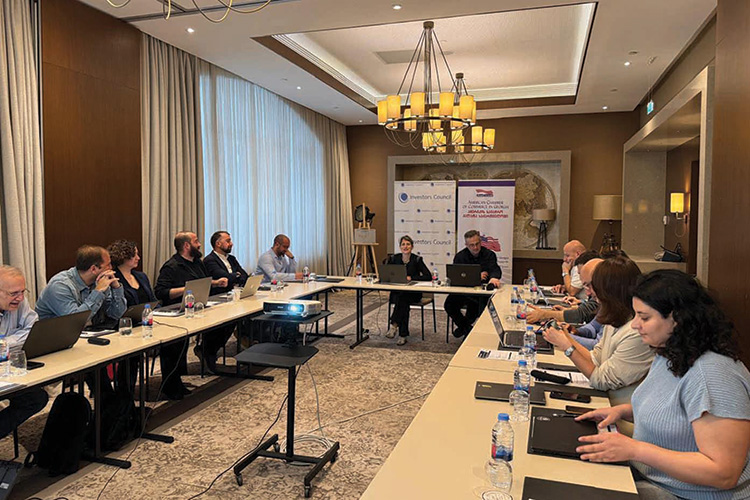
- The first session, co-organized with the Investors Council in Borjomi, gathered active CLT Committee members for two days of in-depth examination of the law’s provisions. Participants reviewed legal articles line by line, identified areas requiring clarification, and agreed on specific amendment proposals.
- A subsequent full-day session in Tbilisi later in the year was dedicated to finalizing the consolidated package of recommendations, aligning viewpoints across stakeholders, and agreeing on precise language for draft amendments.
The resulting draft package was incorporated into the Investors Council’s broader legislative submission prepared for presentation to the Georgian Parliament, marking the conclusion of AmCham’s contributions to the review process.
AmCham’s perspective on these developments were outlined in a February–March 2025 Investor piece, which summarized key business concerns, the practical challenges created by current provisions, and the committee’s recommendations for a clearer, more predictable, and business-friendly corporate governance environment.
Responding to new regulatory proposals: reviewing FARA legislation
Following the introduction of the Foreign Agents Registration Act (FARA) legislation in the spring of 2025, the CLT Committee launched a review process. The committee convened legal practitioners to examine the draft law and anticipate its practical impact on various actors. Discussions focused on the operational consequences and registration requirements as the committee aimed to understand how the regulation would function in practice. These discussions ensured that the AmCham CLT Committee members were substantively informed about the scope of this new legislation.
Labor migration law changes: addressing practical challenges for foreign workers and employers
Substantial amendments to Georgia’s Labour Migration Law entered into force in early summer 2025, with far-reaching implications for foreign nationals engaged in economic activities in the country. The CLT Committee undertook a detailed review to assess the practicality and immediate impact of the new framework.
Key concerns identified included:
- overly broad or undefined terms, including “self-employed foreigner”;
- potential applicability to entrepreneurs, foreign company directors, remote workers, or shareholders with limited ties to Georgia;
- possible requirements for visas and work permits for short-term visits;
- significant financial penalties;
- wide-ranging labor inspectorate powers;
- immediate enforceability of deportation orders pending appeal.
To support informed dialogue, a formal position paper produced by the CLT Committee was submitted to the Investors Council recommending clarification of definitions, refinement of applicability criteria, and improvements to the predictability of enforcement. The committee emphasized the need for balanced regulation that protects the labor market while supporting international investment and mobility.
With input from practitioners and committee members, these issues were examined in an October–November 2025 Investor piece, outlining how the recent tightening of labor migration rules affects employers, the new compliance expectations, and the practical challenges companies may begin to encounter.
Strengthening the tax environment
Throughout 2025, the regulatory environment around taxation remained a core focus for the CLT Committee. AmCham continued its active participation in the Investors Council’s tax working group, while also holding multiple internal consultations to consolidate business concerns.
Topics discussed included:
- How statute-of-limitation periods for tax assessments and corrections can be extended, ensuring they are extended only once and apply equally to both the tax authority and the taxpayer.
- Rules on dividend distribution to prevent the same profit from being taxed twice when distributed through multiple layers of ownership.
- Tax advisor’s authorization to represent clients in court.
- General tax administration practices.
These consolidated recommendations were shared through the Investors Council to support evidence-based policy dialogue with counterparts, with the goal of improving compliance certainty and strengthening trust between the business community and tax authorities.

Arbitration: supporting reform of dispute resolution mechanisms
The CLT Committee also continued its engagement on arbitration matters, examining challenges faced by arbitration institutions, arbitrators, and businesses.
Following AmCham’s active engagement at the Investors Council, the Prime Minister instructed the council to establish a dedicated working group in 2024 to assess these issues and explore draft amendments to the Law on Arbitration.
The committee identified several concerns around current arbitration practices in Georgia, including struggles with inconsistent court practices that deviate from international standards, low business awareness and uptake (particularly among SMEs and in the regions), and remaining gaps in procedural clarity and judicial capacity that undermine predictable enforcement. It also provided key recommendations, including refinement of the country’s arbitration legislation to limit unnecessary judicial intervention, an expansion of training and awareness for relevant stakeholders, and strengthening of practical enforcement so the country can credibly position itself as a reliable regional arbitration hub.
AmCham also held a roundtable discussion in November featuring Georgian arbitration experts for its members to explore the changing nature of arbitration in Georgia. Key topics included the pros and cons of arbitration, its potential time and cost advantages, and recent trends in setting aside and enforcing arbitral awards.
With input from the committee’s arbitration exports, a June–July 2025 Investor article reviewed Georgia’s recent arbitration reforms, as well as the gaps that continue to undermine trust in dispute resolution, and the steps needed to create a more reliable system for businesses.
Launching the healthcare committee
In April 2025, AmCham Georgia launched a new Healthcare Committee in response to member interest and increasing sectoral significance. The inaugural meeting brought together a diverse group of stakeholders, including hospitals and medical institutions, insurance and pharmaceutical companies, Big Four firms, laboratories, and IT providers for the healthcare industry.
The committee’s early discussions covered a broad range of systemic priorities, including:
- alignment of Georgia’s healthcare regulations with EU standards,
- development of specialized educational and certification programs,
- addressing gaps in medical and rehabilitation services,
- strengthening professional training,
- digitalization of healthcare systems,
- promoting opportunities in healthcare and medical tourism,
- attracting foreign investment in clinical, academic, and technological sectors.
Given the scale and diversity of issues, plans are underway to form subcommittees in 2026 to ensure structured, sector-specific workstreams.