
Georgia’s remittance map shifts west —but dependence remains
Georgia’s remittance landscape is undergoing a significant realignment. Russia, once the dominant source of money transfers into the country, is steadily losing ground to the United States and European Union. Yet while the changing geography of those flows has made Georgia less dependent on any single source country, it has done little to reduce the economy’s broader reliance on income earned abroad.
Money transfers remain one of Georgia’s largest sources of foreign currency and an essential source of household income. What has changed is where that money is coming from.
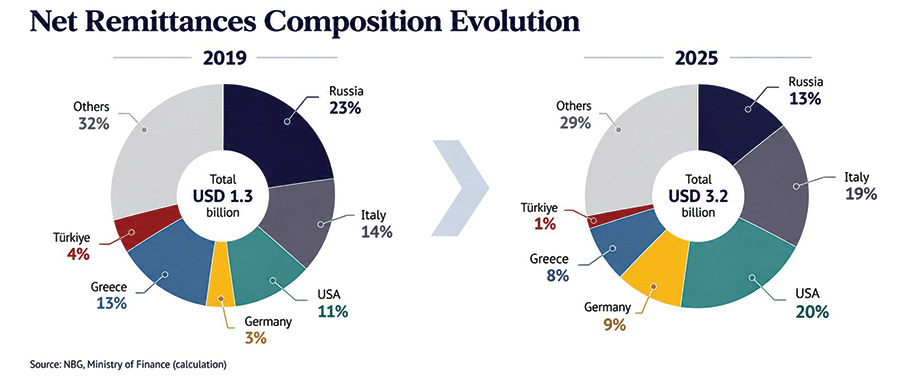
In 2019, Russia still accounted for nearly a quarter of Georgia’s money transfers. By 2025, its share had fallen sharply, while the U.S., Italy, and Germany had all gained ground.
The numbers point to something larger than a reshuffling of Georgia’s remittance rankings. They reflect a gradual westward movement in Georgian migration, and a remittance base that is becoming considerably more diversified.
From Russian surge to normalization
The most dramatic distortion in recent remittance data came after Russia’s invasion of Ukraine.
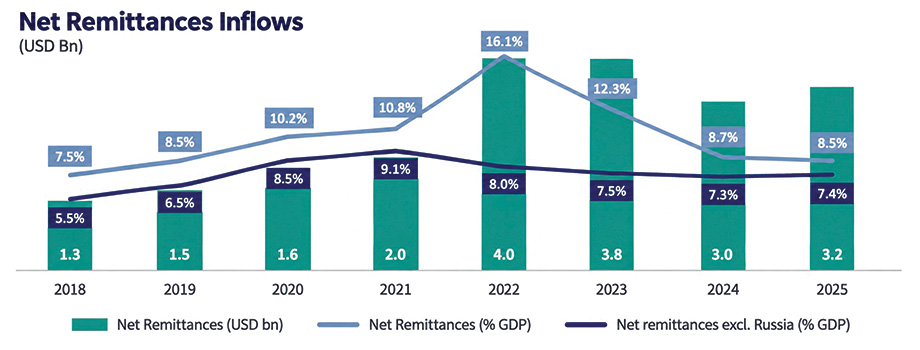
Total money transfers into Georgia rose from around $2.35 billion in 2021 to $4.37 billion in 2022, according to NBG data. Of that, approximately $2.07 billion, or 47%, originated from Russia.
The surge coincided with a large influx of Russian citizens and capital into Georgia and was one of several exceptional external inflows that helped propel economic growth during the period.
But it did not last. Transfers from Russia fell to roughly $1.53 billion in 2023 and then to around $541 million in 2024. By 2025, Russia’s share of total transfers had fallen well below its wartime peak.
What is perhaps more notable, however, is that the disappearance of those exceptional Russian inflows has not caused Georgia’s overall remittance market to collapse. Instead, transfers from the U.S. and Europe have continued to expand.
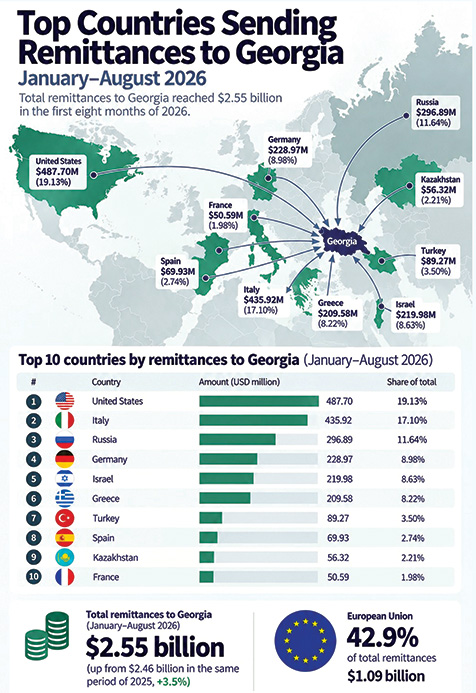
“There are several interesting trends. The first is the decline in transfers from Russia. The growth in transfers from the U.S. is also notable, with transfers from the U.S. and Italy now exceeding those from Russia,” economist Giorgi Khishtovani told BMG last year.
The remittance map follows migration
The United States has been one of the clearest beneficiaries of that change. Transfers from the U.S. totaled around $284 million in 2021. By 2024, it had become Georgia’s largest source of net money transfers, with IMF calculations putting U.S. transfers at roughly $560 million, ahead of both Italy and Russia.
The longer-term trend is even clearer. Between 2019 and 2025, transfers from the U.S. increased by 285%, according to Ministry of Finance calculations. Over the same period, the U.S. share of total transfers nearly doubled from 11% to 20%, while Russia’s fell from 23% to 13%.
Europe’s role has expanded just as noticeably. Italy accounted for approximately 19% of transfers in 2025, while Germany’s share tripled from around 3% in 2019 to 9%. In absolute terms, transfers from Germany rose more than sixfold during the period.
That growth broadly mirrors changes in Georgian migration. A recent IMF analysis found that Georgian emigrants are increasingly moving toward OECD countries, particularly in Western Europe, marking a gradual departure from the post-Soviet migration patterns that made Russia the primary destination for Georgian workers for decades.
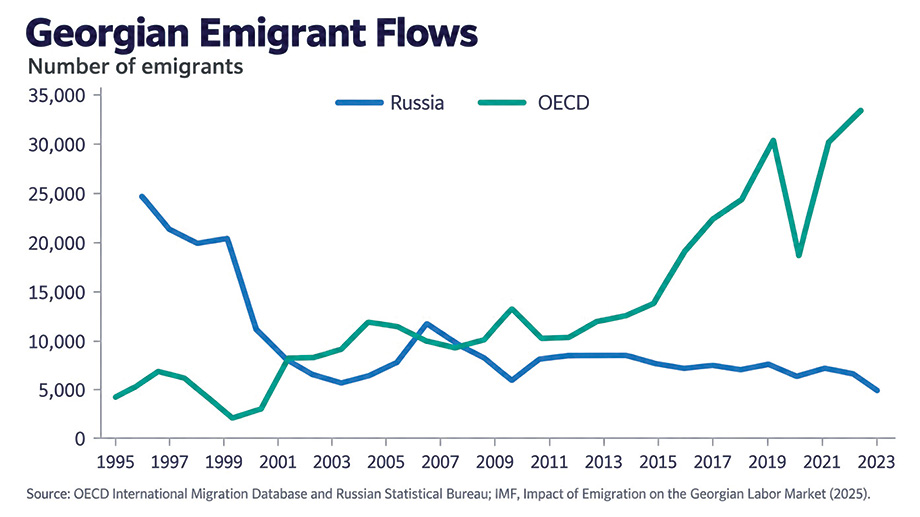
Italy, Germany, Spain, and France are now among the principal destinations for Georgians moving to OECD countries.
Irakli Zhvania, managing partner of audit and consulting firm Kudos Georgia, links the evolving composition of transfers directly to migration.
“The U.S. and Italy have always been among the leading countries and today they are the leaders. This is driven by the growing number of people living there,” Zhvania told BMG in an interview last November. “The increased number of emigrants explains why Europe and America are leading, and this is likely to continue unless there are significant changes.”
More diversified—but still highly dependent
For Georgia, this diversification carries clear advantages. Heavy exposure to a single country leaves remittance-dependent households vulnerable to economic downturns, currency volatility, or regulatory and political changes in that market. A broader mix of source countries spreads that risk.
The years since 2022 demonstrate the point. Russia’s share of transfers has fallen sharply, but stronger inflows from the U.S., Italy, Germany and elsewhere have cushioned the decline.
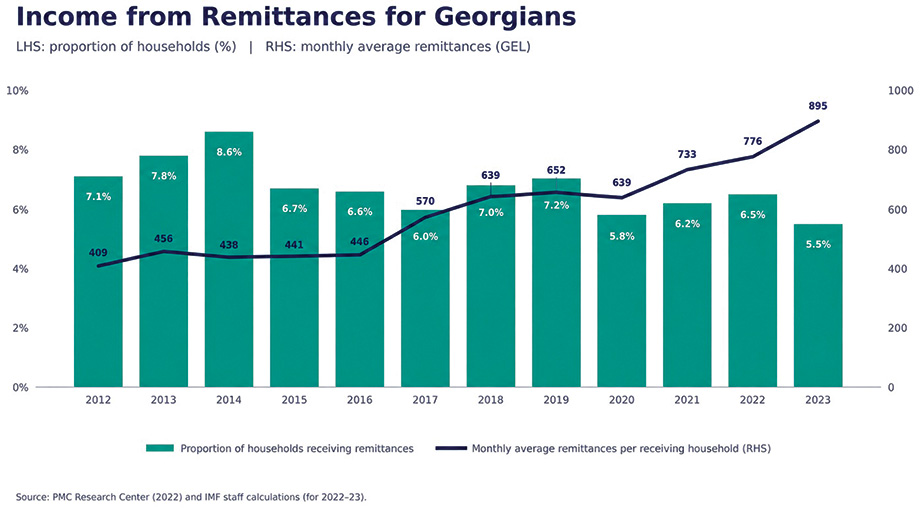
According to Ministry of Finance estimates, net remittances reached around $3.2 billion in 2025, more than double their 2019 level. But diversification should not be confused with declining dependence.
Khishtovani argues that remittances have become even more important as foreign investment has weakened. “Remittances have become one of the main groups of inflows,” he told BMG. “This money flows entirely into the economy.”
Their importance also extends well beyond household budgets.
“Of course, when we are talking about 8-9 billion GEL a year, we understand that it has critical importance for the economy,” Khishtovani said. “A large share of this money goes into investment. Many Georgians working abroad invest in real estate, while it also flows into consumption because families are supported with this money.”
At that scale, remittances are not simply a household-finance story; they have implications for domestic demand, the property market, and Georgia’s external balance.
In 2024, net money transfers amounted to around $3 billion, equivalent to roughly 9% of GDP. According to the IMF, around 6–7% of Georgian households receive remittances, and among those households, the transfers account for roughly 40–45% of monthly income.
Those figures also require some caution, because “remittances” are not measured consistently across institutions. Remittances sent home by migrant workers are only one component of the NBG’s broader money-transfer statistics, which can also include transfers by non-Georgian residents. The NBG, Ministry of Finance, World Bank, and IMF therefore use somewhat different definitions, meaning headline figures are not always directly comparable.
Even so, the broader picture is clear: income earned abroad remains economically vital for Georgia.
The other side of the inflows
The same flows that strengthen household finances also reveal something less positive: continued emigration.
While transfers sent by Georgian emigrants support consumption and investment, outward migration can simultaneously deepen labor shortages and accelerate longer-term demographic pressures—challenges the IMF has already identified in Georgia.
Khishtovani nevertheless expects the importance of remittances to remain high. While growth was relatively weak at the beginning of 2025, he noted that transfers accelerated during the second half of the year.
That trajectory is also reflected in forecasts. The IMF projects remittances under its own statistical definition at around $2.61 billion in 2026, rising to $2.93 billion in 2027 and $3.26 billion in 2028.
The dynamic therefore cuts both ways: the same migration that strengthens Georgia’s foreign-currency inflows can also weaken its domestic labor supply. Georgia’s remittance story is increasingly one of diversification but not diminishing dependence. As the country’s economic links shift westward, its exposure to any single source market may be declining—but the importance of income earned abroad remains firmly embedded in the economy.