
TBC Capital || Georgia navigates a more uncertain global economy

While global markets continue to grapple with geopolitical instability and elevated energy price volatility, Georgia’s economy has entered 2026 from a position of relative strength, according to TBC Capital’s latest analysis presented to AmCham members on May 14. Although international risks remain elevated—particularly following renewed tensions in the Middle East—analysts say Georgia’s diversified external inflows, strong export performance, and continued tourism growth are helping the country maintain economic resilience.
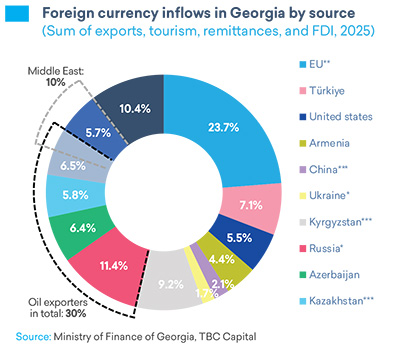
Recent escalation involving Iran, Israel, and the U.S. has once again placed pressure on global energy markets, particularly through disruptions surrounding the Strait of Hormuz, a critical route for global oil and LNG transit. Rising oil prices have renewed inflation concerns glob-ally and prompted markets to reassess expectations for interest rate cuts across major economies.
Despite these developments, Georgia’s direct exposure to the crisis remains comparatively balanced. TBC Capi-tal analysts estimate that the Middle East accounts for roughly 10% of Georgia’s foreign currency inflows through tourism, exports, remittances, and investment, while the country’s overall inflow structure remains diversified across multiple regions and partners. Although Georgia is a net oil importer, it also indirectly benefits from inflows connected to oil-exporting coun-tries, helping offset part of the pressure from higher energy costs.
Analysts further note that, from Georgia’s perspective, developments surrounding the Russia–Ukraine war remain more economically significant than the Middle East conflict. A potential resolution to the war could reduce some of the extraordinary inflows and above-trend economic activity Georgia has experienced since 2022, while de-escalation in the Middle East is expected to have a more neutral impact overall.
Domestically, economic activity has remained robust in early 2026. TBC Capital estimates that GDP growth accelerated to approximately 9.1% year-over-year in the first quarter, supported largely by strong exports. Georgia’s external position also remains relatively strong. Diversified inflows and stable monetary conditions have helped support the lari despite height-ened international volatility. The currency has now strengthened to pre-escalation levels, while the NBG has continued reserve accumulation, reflecting the favorable external backdrop.
REAL ESTATE
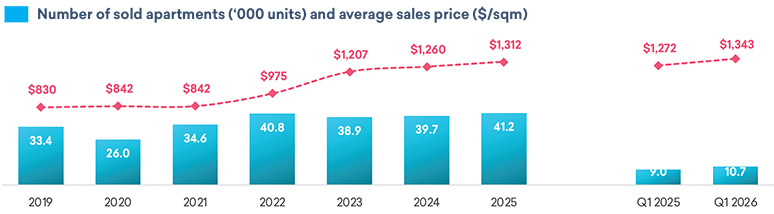
Georgia’s real estate sector is continuing its transition into a more stable phase following the rapid expansion seen in recent years. TBC Capital analysts expect transaction volumes in Tbilisi to increase by 7.1% in 2026, with prices rising 5.6%. Rental markets have also stabilized after the sharp increases recorded during the migration wave of 2022-2023. A slight correction in rental prices (-2.1%) is expected, and average rental yields are projected to remain around 8% in 2026.
TOURISM
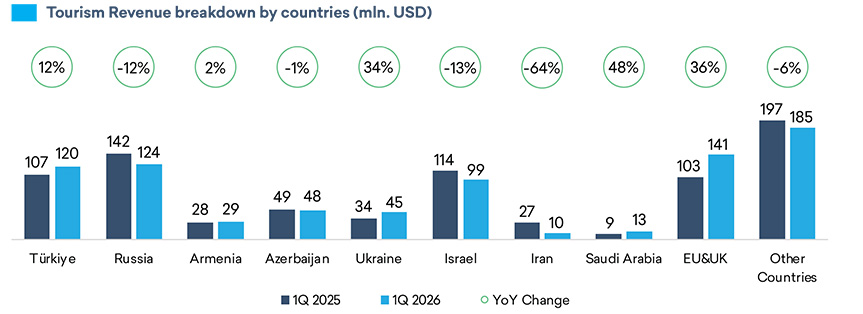
Georgia’s tourism sector remained relatively resilient in the first quarter of 2026 despite regional geopolitical uncertainty. International visits totaled 1.17 million, broadly stable year-over-year, as a 4% increase in tourist trips offset a 19% decline in same-day visits. Tourism revenues reached approximately $830 million, up 0.5% annually.
TBC Capital analysts highlighted strong growth from several key markets, including the EU and UK (+36%), Saudi Arabia (+48%), Türkiye (+12%), and Ukraine (+34%), which helped offset weaker inflows from Russia (-12%), Israel (-13%), and Iran (-64%).
Under its baseline scenario, TBC Capital expects international tourism visits to grow 3% and tourism revenues to increase 2% in 2026, although prolonged regional instability could weigh on the sector’s outlook.
LOGISTICS
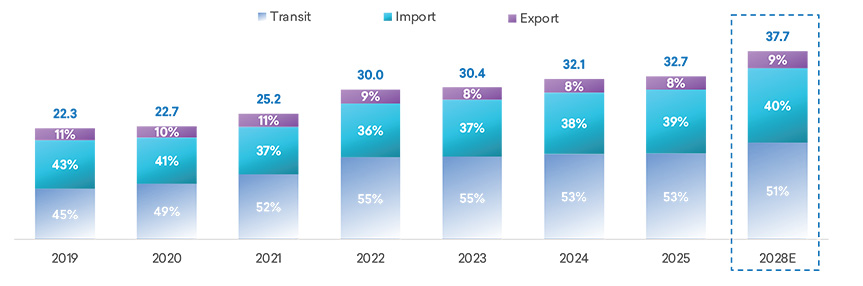
Georgia’s logistics and transportation sector has expanded steadily in recent years, with freight turnover growing at a 7% CAGR between 2019 and 2025, increasing from 22.3 million tons to 32.7 million tons. TBC Capital analysts project volumes will reach 37.7 million tons by 2028, supported by rising domestic demand, export growth, and expanding Central Asian trade flows.
Transit cargo accounted for 53% of freight turnover in 2025, while imports represented 39% and exports 8%. Railway, road, and maritime transport each maintained a relatively balanced share of international freight transportation.
TBC Capital highlighted Georgian Railway’s new $1.7 billion modernization plan, which aims to double rolling stock capacity from 15 million to 30 million tons annually and reduce transit time from 24 to 12 hours.
Georgia is also playing an increasingly important role in the Middle Corridor connecting Europe and Central Asia. Approxi-mately 4 million tons of Middle Corridor freight were transported through Georgia in 2025, with TBC Capital expecting volumes to increase to 4.6 million tons in 2026 under its baseline scenario. Analysts further note that geopolitical tensions in the Middle East could modestly increase demand for the corridor in the near term as some Central Asian trade flows seek alternatives to routes passing through Iran.