
Georgia’s tourism sector: new markets cushion regional shock
Georgia’s tourism sector entered 2026 facing a familiar risk: its exposure to geopolitical developments beyond its borders. Conflict in the Middle East disrupted air travel and weakened several of the country’s higher-spending source markets during the first half of the year. Yet beneath the decline in headline visitor numbers, the picture was considerably more resilient.
Georgia recorded just over 3.05 million international traveler visits between January and June, down 3.3% year-on-year, while tourism revenues fell 2% to $1.9 billion. But the number of actual tourist visits—which exclude same-day visitors—remained virtually unchanged at 2.27 million, edging up 0.1% from a year earlier.
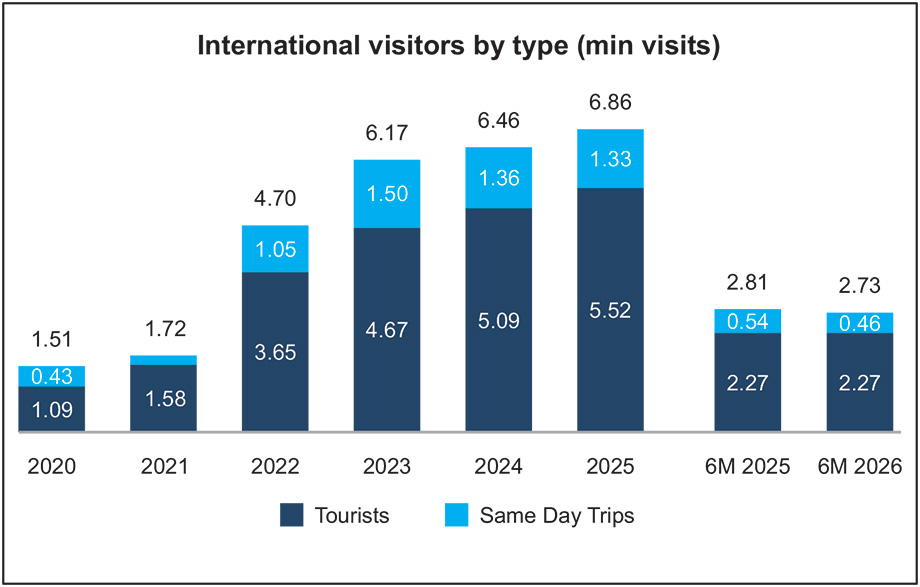
The difference is significant. Rather than a broad contraction in tourism, the first half of 2026 was characterized by a shift in where Georgia’s visitors were coming from—and how much they were spending.
Declining arrivals and revenues from parts of the Middle East were increasingly offset by growth from Europe and emerging markets such as China. For a tourism industry repeatedly exposed to external shocks over the past decade, that diversification may prove as important as overall growth.
Middle East disruption hits high-spending markets
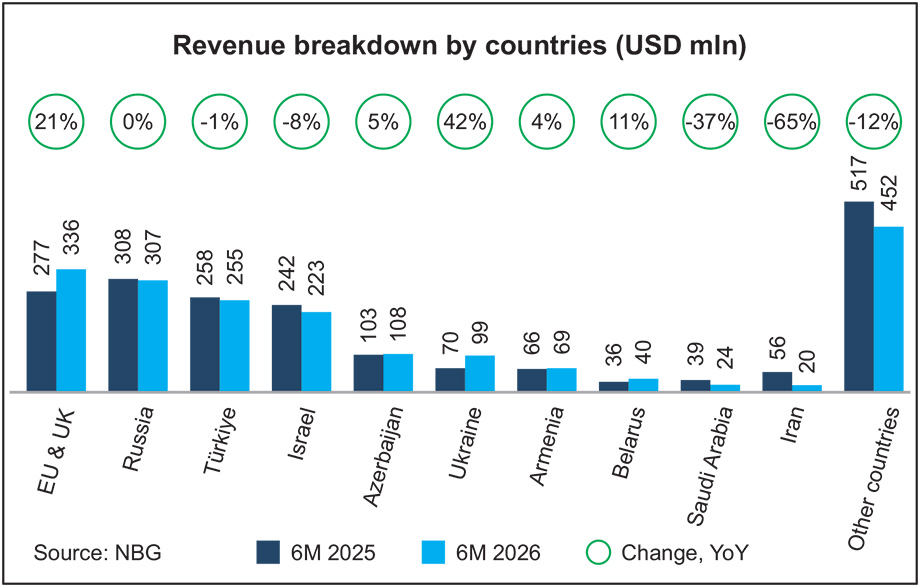
The effects of regional instability became particularly visible during the first half of the year. Israeli visits fell 14.4% year-on-year, according to TBC Capital, while tourism revenues from Israel declined 7.8%, from $242 million to $223 million.
The contraction was considerably sharper elsewhere in the region. Revenues from Saudi Arabia fell 37.3%, from $39 million to $24 million, while revenues from Iran plunged by around 65%, to just under $20 million.
Iran also illustrates how geopolitical developments can continue to affect tourism even after the immediate disruption subsides. The number of Iranian visitors fell 49% year-on-year to 29,397 in the first half of 2026. While Iran accounts for a relatively modest share of Georgia’s overall tourism revenues, at around 2.6%, connectivity with the market now faces further pressure. In September, expanded U.S. sanctions targeted a number of Iranian airlines, including five that had been operating flights to Georgia. Georgia’s Civil Aviation Agency subsequently said the country would comply with the international sanctions regime, potentially further restricting air links between the two countries.
The impact of the Middle Eastern downturn is particularly important because visitor numbers alone do not capture the economic weight of individual markets.
“The Middle East is important not only because of the number of tourists, but because these tend to be high-spending markets,” Irina Kvakhadze, Senior Vice President at TBC Capital, tells Investor. Israel is a particularly telling example: despite accounting for a much smaller number of visits than neighboring Turkey, she notes, the revenue generated by Israeli visitors comes close to that of the Turkish market.
This disruption was felt on the ground.
At Anapea’s Village, a hotel in Kvareli that opened in May 2025, General Manager Giorgi Sikharulidze says summer occupancy was around 4–5% lower than last year. While overnight stays by foreign guests increased, the hotel saw fewer visitors coming specifically for its restaurant, tastings, and masterclasses. The decline was particularly noticeable among Israelis.
That experience illustrates one of the complications behind Georgia’s national tourism figures: shocks to individual markets do not affect every part of the industry equally. Hotels, restaurants, wineries, and other tourism businesses can experience very different conditions depending on their location and customer mix.
Indeed, TBC Capital’s hotel data point to a stronger picture at the upper end of the accommodation market. Average occupancy at the large branded hotels it tracks reached 58% in the first half of 2026, four percentage points higher than a year earlier, while the average daily room rate rose 7% to $134.

Europe moves in the opposite direction
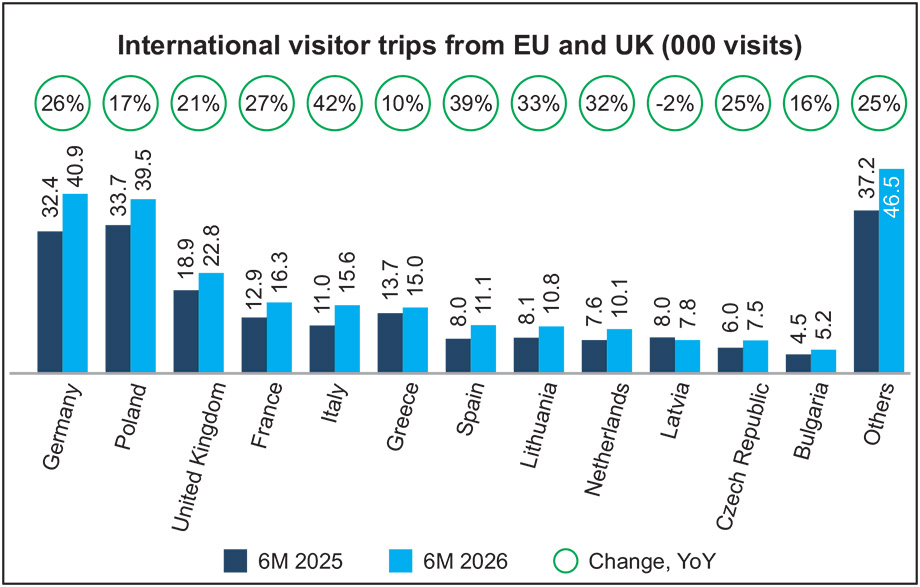
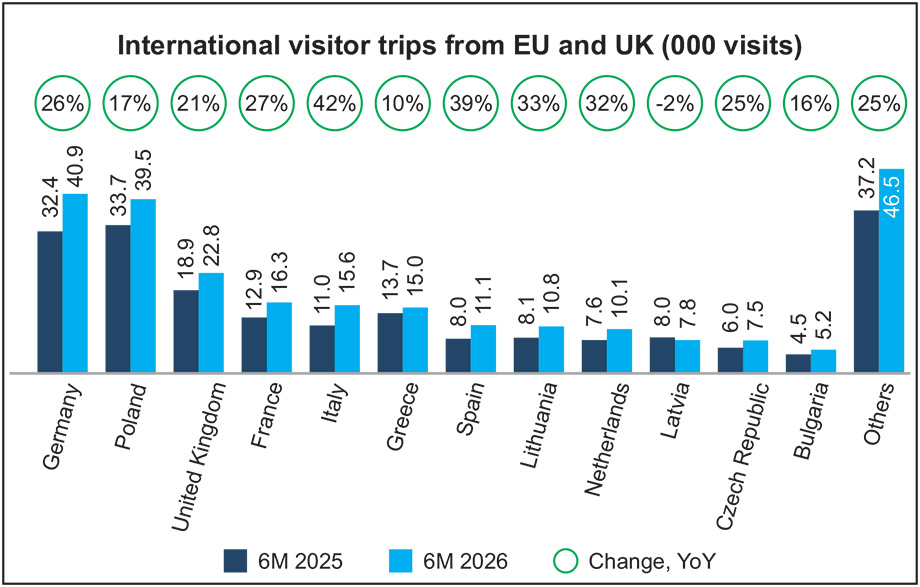
While Middle Eastern markets weakened, Europe provided an important counterweight. Visits from the EU and United Kingdom reached a record 249,201 in the first half of the year, up 23.4% from the same period in 2025. Twenty-six of the EU’s 27 member states recorded year-on-year growth, including increases of 21% from Germany, 10.1% from Poland, and 28% from France.
More importantly for the sector, revenues followed visitors upward. Tourism receipts from the EU and UK climbed 21.2%, or $58.6 million, to a record $335.7 million during the first six months of the year—the largest increase in absolute terms among Georgia’s source markets.
That makes Europe’s expansion more than a story of replacing lost visitor numbers. It is increasingly becoming a substantial source of tourism income.
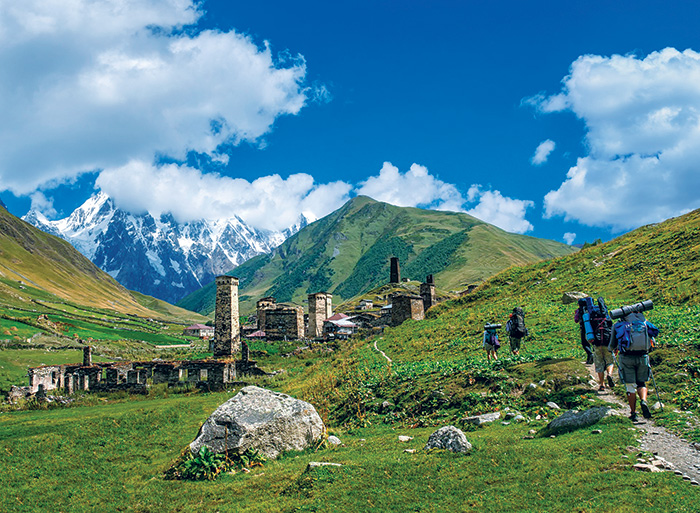
The impact, however, has not been felt uniformly across Georgia’s regions. In Mestia, guesthouse administrator Nana Grigalashvili says the 2026 summer season felt weaker despite continued demand from Polish visitors. The biggest change she observed was the composition of guests: fewer foreigners and more domestic tourists.
“Last year, for example, we had both Georgians and foreigners, and that balanced things out,” she says. “This year, it is mainly Georgians, and they cannot stay for as long as foreign visitors do.”
For Svaneti, the implications extend well beyond hotels and guesthouses. Grigalashvili points to transport providers, restaurants, producers of Svanetian salt, and local craftspeople as among the businesses dependent on visitor spending.
“Almost every family depends on tourism,” she says. “A bad season has a negative impact on the local population.”
Her experience also highlights the limits of national-level data. Stronger arrivals from a particular market do not necessarily translate evenly across destinations, particularly in more remote regions where accessibility, seasonality, and length of stay play an outsized role.
Diversification becomes the buffer
Beyond Europe, several smaller markets are also expanding. Visits from Ukraine rose 23% in the first half of 2026, according to TBC Capital, while China continued its rapid emergence as a source market. GNTA recorded 54,554 visits from China during the first six months of the year, up 16.7% year-on-year.
The numbers remain relatively small compared with Georgia’s traditional neighboring markets, but the direction is significant.
“A diversified market means that if there is a shock in one market, another market can balance it out,” TBC Capital’s Kvakhadze says.
China, she argues, offers particular long-term potential because of the sheer size of the market and improving direct air connectivity.
And Georgia has been putting money behind that opportunity. In April, GNTA awarded Beijing Shi Dai Yi Feng Information Technology a $1.48 million contract to run a tourism marketing campaign in China during 2026, including promotion through WeChat, Weibo, and other Chinese platforms, as well as roadshows and media activities. Chinese visits had already risen 44% in 2025 to approximately 128,000, according to data cited by BMG.
Connectivity is expanding elsewhere as well. GNTA reported in July that a record 85 airlines were operating across 125 routes from Georgia, including new Shanghai–Tbilisi flights operated by China Eastern Airlines. European connectivity has also expanded, with direct flights linking Georgian international airports to 42 destinations across the EU and UK.
Could Azerbaijan provide another source of growth?
Another potential source of growth lies much closer to home. Although Azerbaijan does not represent the highest-spending segment, it was previously Georgia’s largest source of international visitor trips. In 2019, Georgian National Tourism Administration data recorded more than 1.5 million visits from Azerbaijan, ahead of all other source countries. Much of Georgia’s tourism at the time was driven by its immediate neighbors: more than three-quarters of international visitor trips from foreign citizens came from Azerbaijan, Armenia, Russia, and Turkey.
That flow was sharply disrupted after Azerbaijan closed its land borders to passenger traffic during the COVID-19 pandemic. For Georgia, the effect was particularly significant because of the importance of overland travel: in 2019, nearly 75% of all international visitor trips entered the country by land. The Red Bridge crossing with Azerbaijan alone accounted for 16% of all international visitor trips that year.
One connection has now returned. Daily passenger rail service between Baku and Tbilisi resumed on May 26 after a six-year suspension. While this does not amount to a full restoration of pre-pandemic travel flows, improved connectivity creates an opportunity for Georgia to recover at least part of what was once one of its largest sources of regional visitors.
Resilience over rapid growth
The outlook for the remainder of 2026 remains cautious. Galt & Taggart expects international tourist arrivals to grow at a low single-digit rate this year. Earlier in the year, the investment bank revised its tourism revenue forecast from $5 billion to $4.9 billion in response to regional tensions, while identifying stronger arrivals from the EU, China, and Russia as factors supporting the market.
But the first half of the year suggests that the more consequential change in Georgian tourism may be happening beneath the headline growth rate. The decline in Middle Eastern traffic exposed the sector’s continuing sensitivity to geopolitical shocks, particularly when disruptions affect relatively high-spending visitors. At the same time, record European arrivals, continued growth from China, and improving transport links with Azerbaijan show a source-market base that is becoming broader.
Georgia’s tourism sector therefore emerged from a difficult first half neither booming nor in retreat. Instead, it demonstrated something potentially more valuable for its long-term development: a growing ability to absorb weakness in one market through gains elsewhere.
That does not eliminate Georgia’s exposure to external shocks. But in a region where geopolitical disruption has repeatedly reshaped travel flows, diversification is increasingly becoming the tourism industry’s most important form of insurance.