
TBC Capital || Georgia’s beverage sector: Growth on tap as competition rises
Georgia’s beer and non-alcoholic beverage sector is expanding, but the composition of that growth is becoming more important than the headline numbers. HORECA activity, tourism, and rising incomes continue to support demand, while imports are taking a larger share of beer consumption and exports are playing a bigger role in non-alcoholic beverages. TBC Capital’s latest report suggests the sector remains fundamentally healthy, but competitive pressure, product mix, and market exposure are becoming increasingly important to future growth.
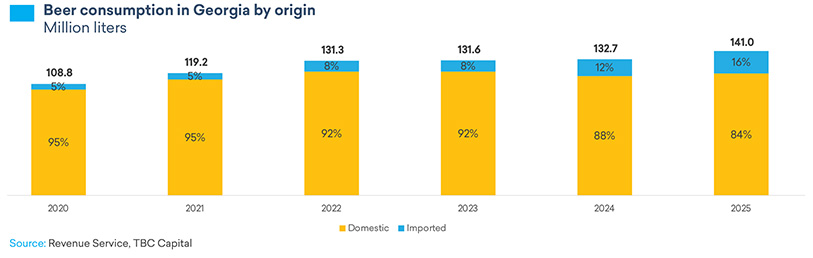
According to TBC Capital’s latest sector report, Georgian beer producers generated GEL 636 million in turnover in 2025, representing compound annual growth of 12.1% since 2019. Beer consumption, meanwhile, reached a record 141 million liters, up nearly 30% from 2020.
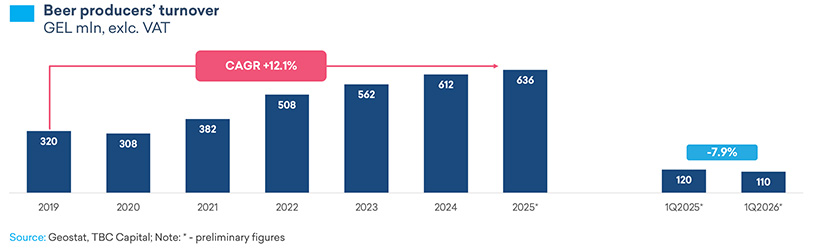
Yet that expanding market has not translated into higher production for Georgian brewers. Domestic production peaked at 126 million liters in 2023 before falling to 122 million in 2024 and 114 million in 2025, with the contraction continuing into the first quarter of 2026.
More beer, but more of it imported
The apparent contradiction—record consumption alongside falling domestic production—reflects changing market dynamics. Imported beer accounted for just 5% of Georgian consumption in 2020; by 2025, that share had climbed to 16%. At the same time, Georgian beer exports have declined since 2023.
TBC Capital Senior Research Associate Irakli Urgebashvili says the shift partly reflects changing consumer preferences and purchasing power.
“Consumer preferences appear to be becoming more diversified with a greater demand for international brands, different beer styles, and premium products,” Urgebashvili notes, adding that rising incomes, modern retail, HORECA and Georgia’s sizable tourism sector are also increasing the visibility and accessibility of international brands.
But he cautions against interpreting imports as a structural threat to local brewers. Domestic beer still accounts for the vast majority of consumption, while the overall market is also expanding. Competition is likely to be more pronounced in premi-um segments, where consumers tend to be more brand- and variety-oriented and less price-sensitive.
There may also be further room for the market itself to grow. Per-capita beer consumption has risen nearly 21% over the past five years yet remains below levels seen across much of Central and Eastern Europe. Still, Urgebashvili cautions that Geor-gia’s strong wine and spirits culture may limit how closely consumption converges with Europe’s highest-consumption beer markets.
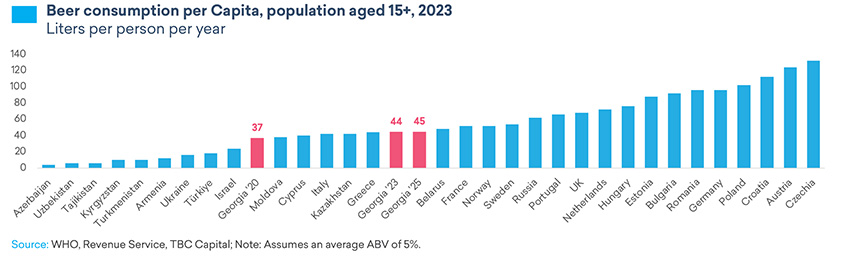
Increasing purchasing power could instead mean that “market growth in value terms may outpace growth in liters consumed,” he noted, as consumers shift toward premium local and imported products.
Exports power non-alcoholic beverage growth
The picture is somewhat different for Georgia’s non-alcoholic beverage producers, where exports are becoming an increas-ingly important engine of growth.
Domestic production surged from 299 million liters in 2020 to 500 million in 2024 before slipping 5% to 474 million liters last year. Despite that decline, production value continued rising, reaching GEL 996 million in 2025. Meanwhile, exports climbed from 93.3 million liters in 2021 to 162.3 million in 2025.
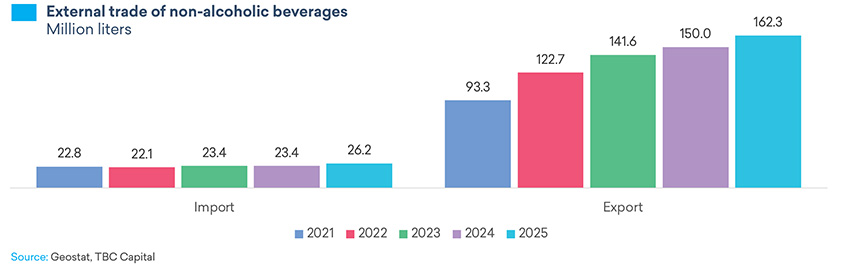
Urgebashvili says the figures suggest Georgian producers have developed the “production capacity, distribution networks, and brand recognition required to serve markets beyond Georgia.”
There is, however, a concentration risk. Russia accounted for 36% of non-alcoholic beverage exports in 2025, followed by Kazakhstan at 16%, Azerbaijan at 15%, Armenia at 11%, and Uzbekistan at 6%. That leaves producers exposed to regional economic conditions, currency movements, trade policy and geopolitical risks. Further expansion in Kazakhstan and Uzbek-istan offers significant potential, Urgebashvili says, while entering markets beyond the CIS region could improve the sustainability of export growth.