
The American impact: how U.S. partnership helped shape Georgia’s modern economy

When the United States recognized Georgia’s independence in 1992, the country faced the daunting task of rebuilding its economy from the ground up. The Soviet economic system had collapsed, institutions were fragile, infrastructure was deteriorating, and private investment was scarce.
More than three decades later, Georgia’s economy tells a very different story. While many factors have contributed to the country’s transformation, the U.S. has played a significant role in helping lay the foundations of Georgia’s modern economy. From supporting market reforms and strategic infrastructure to encouraging foreign investment, strengthening entrepreneurship, and fostering a globally minded technology sector, American engagement has extended far beyond diplomacy.
As the United States marks its 250th anniversary, the relationship between the two countries is increasingly defined by business partnerships, investment, trade, innovation, and the thousands of people whose economic ties connect Georgia and the United States.
Building the foundations of a market economy
The earliest years of U.S.-Georgia cooperation focused on creating the conditions necessary for private enterprise to flourish. Throughout the 1990s and early 2000s, the United States became one of Georgia’s largest development partners, helping strengthen public institutions, encourage economic reforms, and support the country’s transition toward a market economy.
As the bilateral relationship deepened, economic cooperation became increasingly institutionalized. In 2005, the Millennium Challenge Corporation (MCC) signed its first compact with the Government of Georgia, committing $295.3 million over five years to rehabilitate regional infrastructure and improve access to jobs and markets. Following the 2008 war, the MCC approved an additional $100 million to support regional infrastructure and energy rehabilitation. After the first compact concluded, a second $140 million compact was signed in 2013 to strengthen science, technology, engineering, and mathematics (STEM) education and improve the quality of Georgia’s education system. Together, the two compacts invested more than half a billion dollars in infrastructure and human capital, laying important groundwork for the country’s long-term competitiveness.
The relationship was further reinforced in 2009 with the signing of the U.S.-Georgia Charter on Strategic Partnership, which identified economic, trade, and energy cooperation as one of the four pillars of bilateral relations alongside democracy, defense and security, and people-to-people exchanges. The Charter also reaffirmed support for Georgia’s participation in the Generalized System of Preferences (GSP), allowing many Georgian products to enter the U.S. market duty-free and encouraging closer commercial ties.
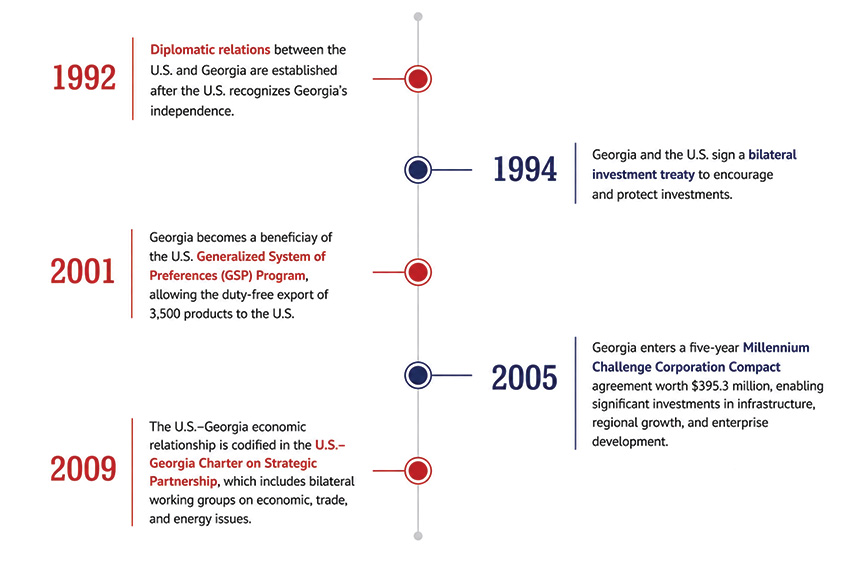
Alongside these flagship initiatives, the U.S. Agency for International Development (USAID) supported a broad range of programs extending well beyond traditional development assistance. Over the years, USAID helped advance agricultural modernization, tourism development, workforce training, financial sector reform, energy security, education, and small business development. Between 2015 and 2024 alone, the United States provided approximately $1.5 billion in assistance to Georgia, with nearly half administered through USAID. Economic growth and private sector development remained central priorities throughout that period.
Together, these initiatives marked an important shift. American engagement was no longer focused solely on helping Georgia transition to a market economy; it increasingly aimed to create the institutions, infrastructure, workforce, and commercial framework necessary to attract private investment and sustain long-term growth.
American investment broadens the economy
Few investments have had a greater long-term impact on Georgia’s economy than the development of the East-West energy corridor.
The construction of the Baku–Tbilisi–Ceyhan (BTC) oil pipeline and the South Caucasus gas pipeline fundamentally reshaped Georgia’s role in regional energy markets. While led by an international consortium headed by BP, the projects were strongly supported by the United States, which viewed alternative Caspian energy routes as strategically important. American diplomatic engagement helped facilitate agreements among participating governments and investors, contributing to Georgia’s emergence as a critical transit corridor connecting the Caspian region with European markets.
Beyond their geopolitical significance, the pipelines generated employment, transit revenues, infrastructure investment, and international confidence in Georgia as a destination capable of hosting complex, multibillion-dollar projects. They also demonstrated that the country could successfully support major international investments, encouraging additional foreign companies to consider Georgia as a business destination.
As Georgia’s business climate improved, American companies and investors became increasingly active across a wide range of industries.
International hotel brands helped modernize the country’s tourism sector. These were led by the Sheraton and the Marriott, which opened Tbilisi hotels in the early 1990s, but has since been followed by dozens of others. These brands have raised service standards and supported Georgia’s emergence as a destination for both leisure and business travel. American-backed investment funds and international financial institutions contributed to strengthening the financial sector, improving corporate governance, expanding access to capital, and supporting broader private sector development.
American companies also established operations across consumer goods, healthcare, technology, manufacturing, and professional services, bringing not only investment but also international management practices, workforce training, and technical expertise.
Trade continues to grow
Trade has become one of the clearest indicators of the expanding commercial relationship between Georgia and the United States.
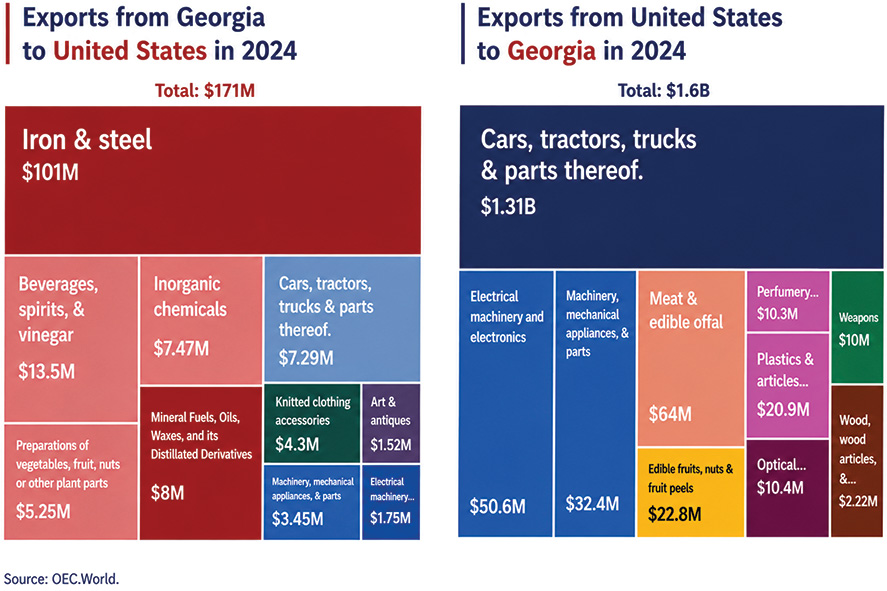
Between 2015 and 2024, bilateral trade increased approximately sixfold, with the United States becoming one of Georgia’s three largest trading partners for the first time. While much of the recent growth has been driven by automobile imports, the broader trend reflects steadily expanding commercial ties between businesses in both countries.
The trade relationship is highly concentrated. Georgia’s imports from the United States are dominated by motor vehicles, particularly used passenger cars. Other key American exports include aircraft and parts, machinery, pharmaceuticals, medical products, food, and alcoholic beverages.
Georgia’s exports to the U.S. are more diversified but still centered on industrial goods. Ferroalloys remain the largest export, alongside wine, mineral water, fruit juice, spirits, cosmetics, pharmaceuticals, trailers, and aircraft parts.
The composition of trade also highlights future opportunities. Although Georgia benefits from the U.S. Generalized System of Preferences (GSP), relatively few eligible products use it. Expanding exports of higher-value goods, processed foods, wine, and technology services could strengthen the relationship further.
Remittances generate billions of dollars
Trade and investment tell only part of the story. Personal remittances sent by Georgians living and working in the United States have become another increasingly important pillar of the bilateral economic relationship.
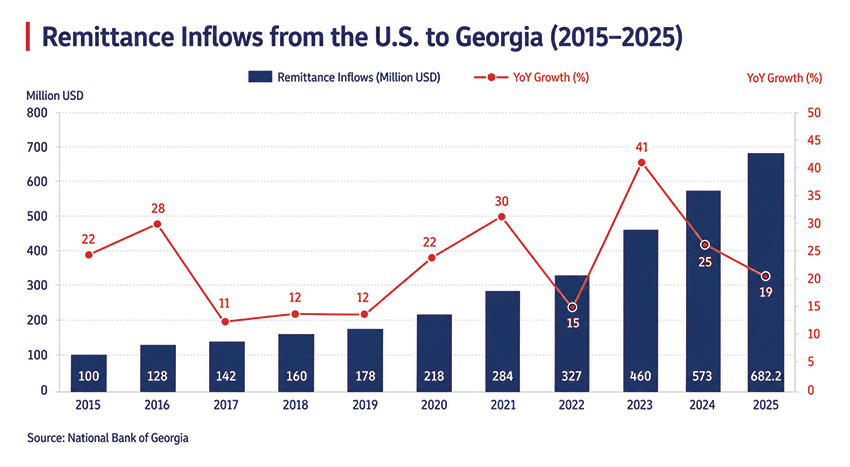
Between 2015 and 2024, remittance inflows to Georgia from the United States increased approximately 5.7 times. By 2024, the U.S. had become Georgia’s largest single source of remittances, accounting for $573 million, or roughly 17% of all money transfers received by the country.
That trend continued in 2025. According to the National Bank of Georgia, remittances reached a record $3.6 billion during the year, with the U.S. remaining the largest single source. Transfers from the U.S. totaled $682.2 million—an increase of 19% compared to 2024—marking the second consecutive year that the United States ranked ahead of Italy and Russia.
While remittances differ from foreign direct investment or trade, they make an important contribution to Georgia’s economy. They support household consumption, education, housing, healthcare, and small business investment while underscoring the growing economic importance of the Georgian diaspora in the United States.
Investing in people
The economic relationship has also been strengthened through investments in people. Alongside trade and investment, educational exchanges and workforce development programs have helped build the skilled workforce needed for Georgia’s growing private sector. Since 1994, more than 2,000 Georgian students have studied in the United States through the Future Leaders Exchange (FLEX) program, joining thousands of other Georgians who have participated in American-funded scholarships, professional exchanges, and leadership initiatives. Many have returned to Georgia to build careers in business, entrepreneurship, and public service, bringing with them new skills, professional networks, and international perspectives.
These educational ties have increasingly been paired with industry-led workforce development. USAID partnered directly with Georgian businesses to develop training programs in logistics, healthcare, automotive services, hospitality, and more—helping address skills shortages in high-growth industries. Together with the Millennium Challenge Corporation’s investment in STEM education and workforce development, these initiatives helped ensure that Georgia’s economic growth was matched by a workforce equipped to meet the needs of modern industries.
From Tbilisi to Silicon Valley
One of the most compelling examples of how the relationship has evolved can be seen in Georgia’s technology sector. A decade ago, relatively few Georgian startups were competing internationally. Today, many founders build products for global markets from the outset and increasingly view the U.S. as the natural destination for investment, customers, and expansion.
One of the earliest success stories was Pulsar AI. Founded in Tbilisi, the company developed an artificial intelligence platform that automates customer conversations for automotive dealerships. After participating in Silicon Valley’s 500 Startups accelerator and securing investment from American venture capital firms, Pulsar AI was acquired in 2021 by California-based automotive retail technology company SpinCar. Widely regarded as Georgia’s first major startup exit, the acquisition demonstrated that a company founded in Georgia could attract U.S. investors and successfully scale into the American market.
Pulsar’s success did not emerge in isolation. Over the past decade, Georgia has deliberately strengthened connections between its startup ecosystem and Silicon Valley. Beginning in the mid-2010s, Georgian founders increasingly engaged with accelerator programs, investor networks, and targeted outreach initiatives in California. In 2017, a group of Georgian startups pitched to around 50 American investors during an investment mission to Silicon Valley, helping establish relationships that later developed into sustained commercial partnerships. The opening of Georgia’s Consulate General in San Francisco in 2019 further strengthened these ties by maintaining ongoing engagement with venture capital firms, technology companies, and startup networks.
More recently, Theneo has become another example of Georgia’s growing integration into the U.S. technology ecosystem. Founded by Georgian entrepreneurs, the API documentation platform gained international recognition in 2022 after winning both the Web Summit PITCH competition and Georgia’s national Startup World Cup competition. The latter earned the company the opportunity to represent Georgia at the global Startup World Cup finals in Silicon Valley before leading venture capital firms and technology investors. Building on that momentum, Theneo later raised $1.5 million in seed funding from U.S.-backed investors to accelerate product development and international expansion.
These companies are part of a broader trend. Increasingly, Georgian startups are building engineering teams at home while raising capital from American investors, participating in U.S. accelerator programs, and expanding into North American markets. Silicon Valley is no longer viewed simply as an aspiration but as a natural extension of Georgia’s growing innovation ecosystem.
The broader results are also becoming increasingly visible. In 2025, Georgia’s IT exports reached $1.15 billion, up 67% YoY, with the U.S. accounting for approximately 26% of total IT exports, making it the sector’s largest export market. American technology companies have also become major employers in Georgia, creating thousands of high-skilled jobs and deepening commercial ties between the two countries.
Looking ahead
The nature of U.S.-Georgia economic relations has changed considerably over the past three decades.
What began as development assistance aimed at supporting a newly independent country has evolved into a multifaceted partnership built on investment, trade, entrepreneurship, innovation, and strong people-to-people connections.
American engagement has helped strengthen Georgia’s institutions, support strategic infrastructure, modernize industries, attract international investment, and foster a new generation of globally ambitious entrepreneurs. At the same time, Georgian businesses are increasingly finding customers, investors, and strategic partners in the United States, particularly in technology and other high-value sectors.
As Georgia continues positioning itself as a regional hub for logistics, digital services, and innovation, these commercial relationships are likely to become even more significant. Governments establish the framework for cooperation, but increasingly it is businesses, investors, entrepreneurs, and individuals who define the relationship.
More than three decades after diplomatic relations were established, one of the most enduring legacies of U.S.-Georgia cooperation may be the confidence that Georgian companies can compete—not only within the region, but on the global stage.