
Pardon the dust — an update on progress and delays to Georgia’s infrastructure push
Georgia’s infrastructure ambitions remain among the country’s most significant since independence, but progress has been uneven, with several flagship projects delayed or repeatedly reannounced. Against that backdrop, the World Bank’s June approval of a $372 million loan for the TC-GATE section of the Middle Corridor signals that major international lenders continue to support Georgia’s long-term connectivity strategy. Expected to exceed $750 million with co-financing from the Asian Development Bank and Asian Infrastructure Investment Bank, the project is designed to strengthen Georgia’s role as a Eurasian trade corridor and advance its ambition to become a Black Sea logistics hub.
Georgia’s relatively strong macroeconomic fundamentals also help explain continued lender confidence. Both the international credit rating agency Standard & Poor’s (S&P) and the EBRD forecast GDP growth of around 5–6% in 2026 and about 5% in 2027, in line with other major lenders. Public debt remains low at 32% of GDP, foreign exchange reserves reached a record $7 billion in May, and the financial system is widely viewed as stable.
EU grants have fallen sharply—from roughly GEL 105 million to between GEL 7 million and GEL 15 million, depending on the budget classification—while U.S. assistance has also declined. Although these have often funded project preparation and technical assistance, tax revenue—which the government expects to exceed GEL 27 billion in 2026—has continued to grow at a faster pace than the decline in grants and assistance.
A complex pipeline of projects
Progress on Georgia’s infrastructure program is not an easy one to track. The major projects on the list are far from new and doubts have been raised about when—or if—some of them will come to fruition: in addition to the road corridors and modernizing the rail network, there is the Anaklia Deep Sea Port, the Black Sea Submarine Electricity Cable, electricity transmission network expansion (to accommodate locally generated “green” energy), a new airport, and urban and tourism infrastructure. A figure and a timeline of “$7 billion to be spent over the next seven years “was given last December at the Second Trans‑Caspian Transport Corridor and Connectivity Investors Forum by Georgia’s Minister of Economy and Sustainable Development Mariam Kvrivishvili.
However, the pipeline of work is subject to stops and starts and policy changes, as well as project-level cost reductions, postponements, oversight changes, and savings measures.
The Anaklia Deep Sea Port has once again returned to the headlines following the Prime Minister’s April announcement that the government had renegotiated the marine dredging and breakwater contract, reducing the initial allocation to GEL 150 million. However, the announcement largely concerned work already under way—the dredging contract itself was signed in 2024—and did not include major new construction plans or financing arrangements. The revised schedule now pushes the port’s expected opening to 2029, following years of delays since the original private-sector project collapsed. Questions also remain over financing and commercial partners. As BM.ge has reported, the government continues negotiations while maintaining that it will not provide sovereign guarantees on loans or cargo volumes—both preferred Chinese terms.
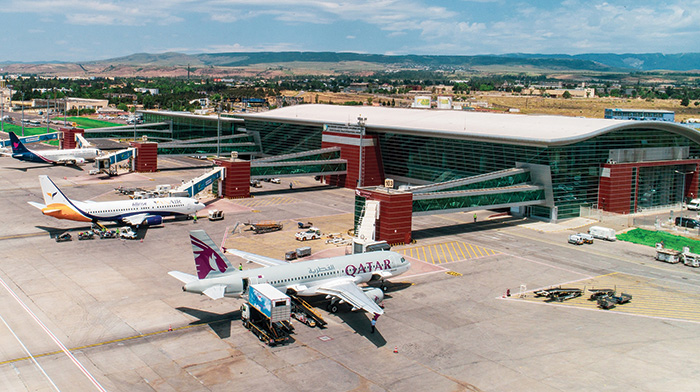
There is also a delay on the new mega airport planned at Vaziani with its operational timeline announced early this year as late 2031. Meanwhile, Turkish airport operator TAV has committed to investing $150 million in the short term to expand the existing Tbilisi International Airport. The investment will double the airport’s annual capacity to 10 million passengers by 2028, while extending TAV’s concession through 2031.
The 900 million GEL Tbilisi national stadium/sports complex has been removed from the 2026 budget framework, having earlier been included in draft plans. Across the regions, smaller sports complexes show uneven but ongoing implementation, but renovations continue largely unaffected.
There has been persistent slippage on the upgrading of Georgia’s aging and, in some places, nonexistent water and sewage infrastructure. Georgia aims for a 24/7 water supply in all towns by 2028 and around GEL 2.5 billion is being invested in the regions nationwide. According to the Georgian Public Broadcaster, in February the infrastructure minister acknowledged existing shortcomings, identifying poor project design as one of the principal obstacles—a problem which, he noted, leads to delays in works. He offered his apologies to residents of those communities still experiencing disruption. But slippage is hardly surprising given funding is coming from a complex mix of funding sources: long-term international development bank loans (ADB), co-financing from the Georgian state and utilities, with supporting EU grants for technical preparation.
The ADB-led program to modernize the electric grid is behind its original implementation schedule, particularly on market development and regulation. So, the final stages of modernization are taking considerably longer than planned, but the project is not considered to be severely off-track—completion by 2027 now forecast in a U.S. Department of Commerce report. Yet even on the infrastructure side, as described in June by First Deputy Finance Minister Giorgi Kakauridze on the BM.ge news channel, there have been challenges. These are primarily related to projects financed by the European Investment Bank, including transmission network upgrades and road infrastructure developments. In some cases, tenders failed to proceed after donors raised concerns regarding potential contractors, forcing the authorities to relaunch procurement processes.
Georgia is aiming to make its electricity sector fully self-sufficient by 2036. There are two regional flagship projects: the Black Sea submarine cable carrying clean electricity under the sea to Europe and the on-land infrastructure, and the Green Energy Corridor, which includes a large-scale electricity interconnector and a green hydrogen component. The Black Sea Cable itself is less important to modernizing the electricity grid than for monetizing it. While not short of commitment or eligibility for funding, these projects have not made substantial progress and are still at the “pre-investment financing structuring phase.”
EU support has been formally strengthened, but final investment decisions and full financing packages are still being assembled. Georgia is contributing an annual 25 million GEL or so annually for the preparatory work. Its contribution will come for converter stations, grid upgrades, and probably a small equity stake.
The challenge of delivering connectivity
Although transport is the overarching priority in government spending, there is also a two-year slippage on the completion of the Kvesheti-Kobi Highway due to engineering complexity and weather, and the 932 million GEL Tbilisi Bypass tender has been postponed multiple times.
Uneven progress in Georgia’s transport connectivity program, as the EU, neighbors, and logistic groups push for Middle Corridor completion, has come largely from implementation bottlenecks. Turkish planners and regional carriers and exporters increasingly speculate in the media on whether Georgia’s transit capacity will ever meet demand. Criticism has come, not for lack of investment (or demand) but on lack of capacity to execute modernization projects and on reliability. To be fair to Georgia, there are bottlenecks and border delays in neighboring countries, too. But the question being asked is: can Georgia maintain its role as the key South Caucasus transit state?
Construction costs have been rising and on some recent tender bids exceeded government estimates by large margins, forcing reassessment and delaying awards. A government attempt to tackle this is being made by introducing indexing mechanisms to adjust contract values.
There are often problems with land acquisition, contractor underperformance, engineering complexity and weather, procurement and tender delays, and administrative capacity constraints. For example, the April postponement of the deadline for the GEL 932 million tender for the 22.5-km Avchala-Airport section of the Tbilisi bypass highway came because participating companies said that in an increasingly unstable international economic environment they wanted more preparatory time.
Continued support from development banks
Fortunately, the remit of the international development banks is just that: to encourage development. Their loan terms seem hardly stressful. The latest World Bank loan is an excellent example, being fairly typical: there is a long grace period which means repayment does not start until 2036 and extends to 2050. World Bank loans normally become accessible 90 days after signing, and payment installments are made on project milestones, contractor invoices, and the progress of the construction work. By 2036, the Georgian section of the Middle Corridor’s transit infrastructure should be at least partially self-funding rather than needing taxpayer support. Georgia has already been earning 150-180 million GEL a year from truck transit fees.
“These investments will help Georgia realize its full potential as a critical regional transit hub bridging Europe and Asia, while responding to growing demand along the Trans-Caspian Transport Corridor, reflecting evolving global trade flows and need for diversified supply chains,” said World Bank Regional Director for the South Caucasus Rolande Pryce in a press release, underlining its view of the strategic importance for the wider region—not just Georgia—of an efficient Middle Corridor.
Efforts to strengthen Georgia’s trade corridor
A comment from Middle Corridor skeptic, U.S.-based think-tank the Carnegie Endowment, notes that the Middle Corridor shows considerable promise as a trade link between China and Europe and as a strategic pathway westward for Central Asia’s vast reserves of critical minerals. Until the TRIPP corridor connecting the Azerbaijani heartland to Turkey via southern Armenia and Azerbaijan’s Nakhchivan enclave becomes operational, Georgia will remain the Middle Corridor’s sole gateway to Europe.
The TC-GATE Project will help modernize Georgia’s inefficient rail freight services with new assets, such as energy-efficient electric locomotives to replace the aging fleet. The upgrades aim to boost “locomotive availability to 95%, improve service reliability for shippers, and support a 20% increase in revenues, while also resulting in a reduction in net emissions of more than 2.3 million tons.” Lack of rail rolling stock has been a constant complaint by Georgian Rail’s potential freight customers.
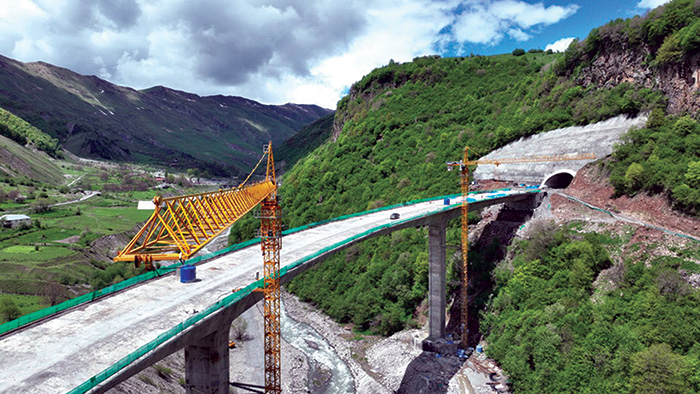
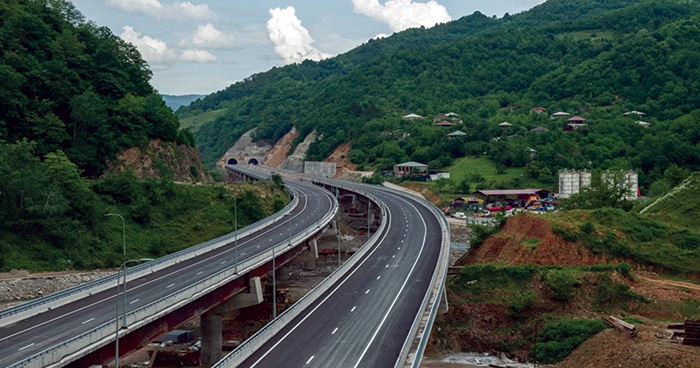
On roads, the project will finance the construction of two four-lane road segments in Georgia’s strategic transit highway. Completion of the East-West Highway, traversing Georgia as part of the Middle Corridor, has for some years been the highest profile of Georgia’s infrastructure narrative. The ADB and the World Bank are enthusiastically encouraging development of the Georgian section, on the grounds that the country needs greater connectivity, stronger exports, and deeper integration into international trade networks to sustain growth.
Overall, Georgia continues to pursue an ambitious long-term infrastructure agenda, supported by strong macroeconomic fundamentals and ongoing backing from international development lenders. Yet progress has been far from linear. While important projects—particularly in rail and the Middle Corridor—continue to advance, others remain delayed or stuck in planning after years of announcements. For international lenders, the question is less whether Georgia’s infrastructure ambitions are worthwhile than whether institutional capacity and project execution can keep pace with those ambitions. As the World Bank itself notes in country evaluation: it observes “improved connectivity infrastructure … however, results depend heavily on institutional capacity and implementation quality.”