
Georgia confronts a changing carbon economy
With EU carbon rules increasingly determining access to one of its most important export markets, Georgia is responding to growing pressure to build the regulatory and reporting systems needed to keep its industries competitive.
Georgia is on its way into a multi-billion-dollar global market—one best known for its place in international efforts to curb climate change. This is the carbon emission control market, which helps mitigate climate change by reducing the amount of greenhouse gases—in particular, carbon dioxide (CO₂)— that accumulate in the atmosphere. Georgia announced its latest steps in the form of legal frameworks for carbon control and new targets in June, laying the groundwork for deeper alignment with EU climate and trade rules.
This is particularly important for Georgia’s major exporters to the EU, such as fertilizer group Rustavi Azot, which needs to operate within a legal carbon framework to receive environmentally friendly new investment. Non-EU producers of cement, iron, steel, aluminum, fertilizers, electricity, and hydrogen exporting to the EU are directly impacted, as is aviation.
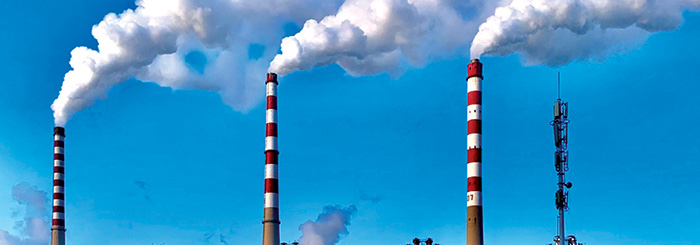
According to the latest World Bank report, global carbon pricing revenues, collected like a tax on emitters, have tripled over the past decade as more and more countries have introduced a mix of laws, pricing systems, and industrial rules to assess and tackle greenhouse gases. The sum mobilized was more than $107 billion for government budgets in 2025. Governments are pushing for renewable energy and electrification, many now pricing emissions to extract revenue for green investment. The EU, widely recognized as a global leader in climate action, operates a cap-and-trade system where companies must buy permits to emit CO₂.
But it is the need for Georgia’s major exporting industries to satisfy EU carbon emission control regulations, not revenue creation, that is currently driving the government’s building of institutional machinery for the country’s greenhouse gas commitments. At this stage, with large industrial exporters a vital part of its economy, Georgia is moving faster than most of its neighbors.
The EU carbon challenge
Starting this year, the EU is imposing a carbon price tariff on imports of products to ensure these have incurred costs that match the carbon emission tariffs being paid by EU producers under the EU Emissions Trading System. If not, the importer must pay a charge based on the embedded carbon emissions in the imported goods, aligned with the price of carbon inside the EU—thus, importers have the hassle of paying the cost difference and going through the bureaucratic process.
So, in the complex, heavily regulated new world created by escalating climate change and governments’ efforts to minimize its impact, Georgia has reached a pivotal inflection point. June’s announcements were on critical developments to ready the country to meet EU CO₂ demands, including: full operation of a carbon emission monitoring, reporting, and verification (MRV) system. Heavy industries—such as steel, cement, and fertilizer—energy production facilities, and aviation operators must all hold official greenhouse gas emissions authorizations to comply with the rules. Businesses are required to submit verified annual carbon emission reports to the state, and independent conformity assessment bodies must audit these metrics before submission.
Building the domestic framework
Minister of Environmental Protection and Agriculture David Songulashvili announced in June a National Adaptation Plan “to serve as Georgia’s first comprehensive framework for the long-term planning, coordination, and integration of climate change adaptation measures into national and sectoral policies.”
As part of the process, a ten-year strategic vision for climate change adaptation and a five-year National Adaptation Action Plan will be developed, including a financing strategy. The phased rollout of the Law on Industrial Emissions directly targets many of the country’s largest companies in terms of employment and exports. This legislation mandates a modernized, integrated permitting system designed to strictly curb water, soil, and atmospheric air pollution.
Georgia signed the Paris Agreement, the legally binding international treaty adopted by nearly 200 countries at the UN Climate Change Conference, back in 2016. But the EU stance on imports has brought urgency, and in June, the country also strengthened previous commitments targeting a 47% reduction in net greenhouse gas emissions compared to 1990 levels by 2030, and one of 50% by 2035. This is moving the country closer to EU trajectories—the EU is targeting net zero by 2050—with 2026 being the first year in which companies are systematically collecting emissions data under the new framework. The EU’s first annual Carbon Border Adjustment Mechanism (CBAM) declaration deadline covers imports made during calendar year 2026 and must be submitted by September 30, 2027.
Georgia’s industrial majors have, in fact, been modernizing their plants to meet overseas customer and IDB emission standards. Large exporters may already have sophisticated environmental-management systems and could be ready sooner, while smaller exporters may need longer to establish data collection procedures and undergo verification.
As yet, Georgia has not announced a carbon price or a date for a carbon pricing system (such as a carbon tax or emissions permit trading system). Carbon costs can be unpopular, causing higher prices domestically for businesses and consumers. For now, Georgia is effectively delegating the collection task for EU traded goods on importers there. The delay also means the loss of potential government revenue, and without local tradeable permits, there can be no carbon market. Plus, Georgia could be disqualified in the eyes of some investors and lenders who now assess on the basis of progress on climate regulation. But the Georgian government appears to be taking a step-by-step approach to carbon markets.
Adjusting to the new sustainable world is creating new Georgian businesses, services, and jobs as a whole new industrial sector forms—financiers, assessors, consultants, and analysts with dedicated skills are emerging. Until now, the focus has not been the carbon markets specifically, but rather the environment as a whole. The Asian Development Bank (ADB) has for some years concentrated on projects spanning energy, transport, water, and urban systems designed to enhance the country’s climate change resilience.
Georgia’s industrial majors
All have been modernizing plants and machinery to meet export market and major lender environmental standards, which will help them comply with the EU carbon regulations. For example:
Rustavi Azot: owned by giant Singapore-based global chemicals group Indorama since 2023, Rustavi Azot is well ahead on “greening” its plants compared to other Georgian majors. Heavily focused on export markets, unlike its peers, it shared an ambitious decarbonization plan nearly two years ago and its plant is currently undergoing a major modernization and decarbonization initiative backed by significant international green financing. Rustavi Azot has attracted loans from the ADB and the EBRD totaling $105 million for this modernizing investment plan. Rustavi Azot is also developing carbon storage in partnership with Block Energy.
Rustavi Steel: its sustainability narrative is mainly operational, not climate-driven—improving technology and equipment, increasing productivity and export competitiveness, and maintaining quality standards.
GeoSteel: In 2026, it highlighted sustainability-linked financing tied to ESG and emissions-related targets, one of the first such programs in Georgian heavy industry. However, since its plant uses scrap metal as a raw material, the manufacturing process is relatively carbon light.
Hunnewell Cement: Cement is one of the hardest sectors to decarbonize. In 2026, the company launched a major modernization project at the Kaspi plant. While not explicitly a carbon-capture project, this type of upgrade is often a prerequisite for future emissions reductions and compliance.
Renewables
Hydro: For a large hydropower plant in Georgia, access to carbon-credit schemes can be difficult if the facility is already operating, since carbon markets generally reward new emissions reductions or removals. New projects face a different hurdle: standards typically require developers to show that carbon revenue is necessary for the project to proceed. Because many hydropower projects can be commercially viable on electricity sales alone, demonstrating “additionality” that the emissions reduction would not have occurred anyway can be challenging.
Solar: Georgia’s electricity is already relatively low-carbon, often getting around 75–80% of its energy from hydropower and other renewables. That means a new solar farm displaces a cleaner grid mix than in countries dominated by coal. The calculated emissions reduction per MWh is therefore smaller than in many other markets. Grid-connected solar projects increasingly face challenges proving additionality because renewable power is often already economically viable. Many modern utility-scale solar projects therefore focus on renewable energy certificates, sustainability reporting, or green-finance classifications rather than generating voluntary carbon credits.
Black Sea Cable: To connect to and sell power through the Black Sea cable, Georgian producers are more likely to need renewable-origin and traceability certification than carbon-credit certification. Carbon certification is optional unless they intend to monetize emissions reductions through carbon markets. The main challenges are grid expansion, connection infrastructure, and renewable-energy certification rather than carbon intensity itself.
Trading in carbon permits
Georgia has built the diplomatic and legal foundations for carbon trading, but it has not yet completed all the institutional and technical requirements needed to issue and transfer internationally recognized carbon credits at scale. The UNDP reported that Switzerland, Japan, and their partners have: “assessed Georgia’s carbon trade readiness, identified legislative and other gaps, and agreed on a technical assistance package.”
Despite signing these carbon-market cooperation agreements, Georgia has not yet become a significant source of internationally transferred carbon credits because the country is still developing the legal, institutional, and accounting systems required.
When Georgia’s first credits do appear, the most likely sectors are forestry/afforestation, municipal waste and wastewater, industrial efficiency, and renewable energy, according to a report from Japan’s environment ministry.
Consultants and development groups
All the major international consultancy firms offer their services for corporate climate strategy, ESG reporting, and carbon-market readiness. Other leading groups working in the Caucasus include:
Swiss-based Southpole: one of the most active global carbon project developers; works on carbon credits, offset projects, and climate finance advisory (including emerging markets like the Caucasus region).
Norway’s DNV: a major provider of carbon verification, emissions auditing, and certification for climate projects and industrial clients.
Swiss-based multinational SGS: has a strong presence in environmental auditing and verification (ISO standards, emissions monitoring, and compliance audits).
Norwegian group Carbon Limits: a specialized climate consultancy focused on carbon pricing, emissions reduction policy, and carbon market mechanisms (often engaged in Eastern Europe and neighboring regions).
GIZ: German development agency, heavily involved in climate policy support, emissions reduction programs, and carbon-market readiness in Georgia through government partnerships.
Finance
The Georgian banks, especially TBC, are actively engaged in “sustainable lending” and green finance, and several are doing so via the EBRD’s Green Economy Financing Facility (GEFF)—supported by Austria—which subsidizes costs on eligible projects from households to large companies, often for construction. The National Bank of Georgia (NBG) has several climate-related initiatives, focused on green finance regulation, climate risk management, and data systems for the financial sector.
The financing side on carbon emission controls is still emerging. Most Georgian banks are not yet lending against future carbon-credit revenues the way some specialist climate-finance funds do in Europe or North America. For a carbon credit-creating forestry project, or a carbon capture & storage project, financing is more likely to come from bank debt, development finance institutions, or carbon-credit purchase agreements.
Block Energy
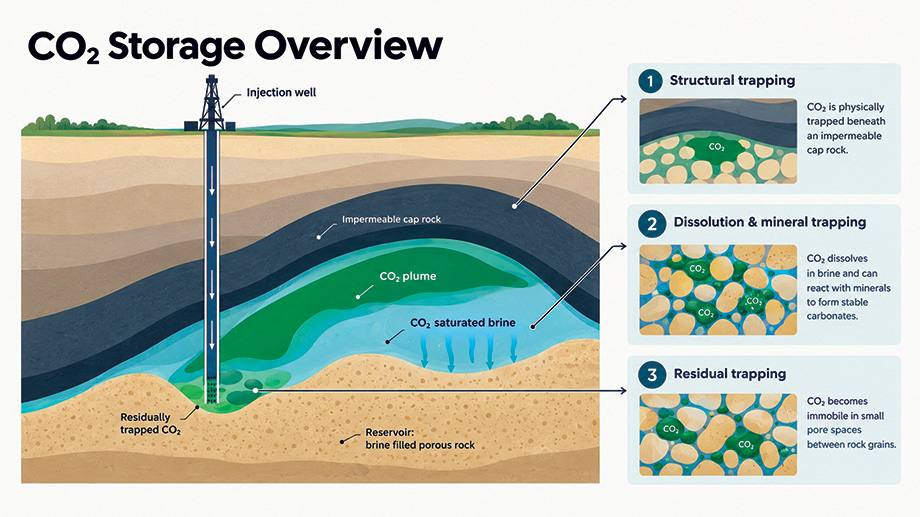
Carbon storage is necessary because it helps lower atmospheric CO₂ levels, making it an important tool—alongside emissions reductions themselves—to manage climate change. Along with its development partner, Rustavi Azot, Georgian small-cap oil and gas explorer Block Energy, hopes to use legacy under-pressured heritage oil wells and reservoirs to provide permanent carbon (CO₂) storage. A pilot study was successful, and Block has now announced that it has moved on to carrying out feasibility work.
Block has focused on its wells in the deep Middle Eocene volcanic formations in the Patardzeuli-Samgori area, where the rocks contain minerals rich in calcium, magnesium, and iron. These elements can react with dissolved CO₂ to form solid carbonate minerals, which is why Block talks about carbon mineralization rather than simple storage. Block has said that studies estimate a CO₂ storage capacity ranking—at both reservoir and basin scales—amongst the highest in Europe.
The process works like this: at a plant like Rustavi Azot, CO₂ is produced in industrial processes and leaves through exhaust streams. Common capture methods include amine scrubbing, which is the most common. The captured CO₂ is compressed to high pressure and then transported, usually by pipeline, before being injected thousands of meters underground through wells. When CO₂ mixes with water it forms weak carbonic acid—similar to sparkling water. That acidic water then reacts with minerals in rocks that contain calcium, magnesium, and iron, and this over time creates solid carbonate minerals, turning into rock. Once the carbon becomes calcite or magnesite, it is essentially stored in the same form that nature has kept carbon underground for millions of years. Block’s licenses are relatively close not only to Rustavi Azot, but also other industrial facilities around the Tbilisi–Rustavi corridor. The investment case depends less on whether the rocks can mineralize CO₂ (they apparently can), and more on whether Block can build a large-scale storage business around that geology.