
A new plan for Anaklia, but no easy path
After years of delays, redesigns, and political controversy, construction at Anaklia Deep Sea Port is finally moving forward under a new state-led model. Whether that model can attract the operators, investment, and cargo needed to make the port commercially viable is now the central test.
Georgia’s Black Sea ports are handling growing volumes of cargo, strengthening the case for additional capacity. In July, the government set out a new approach to Anaklia based on a model used at major ports internationally: the state would provide the core infrastructure, while private companies would develop and operate the terminals. It is a credible framework on paper, but its success will depend on whether experienced operators see a strong enough commercial opportunity to commit.
One positive is that the search for reliable international transport capacity and diversified East-West routes is mounting, as military conflicts block east-west corridors via the Red Sea, the Strait of Hormuz, and access to the Suez Canal. Key to the strategy for Anaklia will be its deep berth capacity, designed to accommodate large container vessels that existing Georgian ports cannot handle. The port’s purpose is to be one of the shortest maritime gateways connecting Asia to Europe—avoiding sanctioned Russia—and thus strategically important for the Middle Corridor.
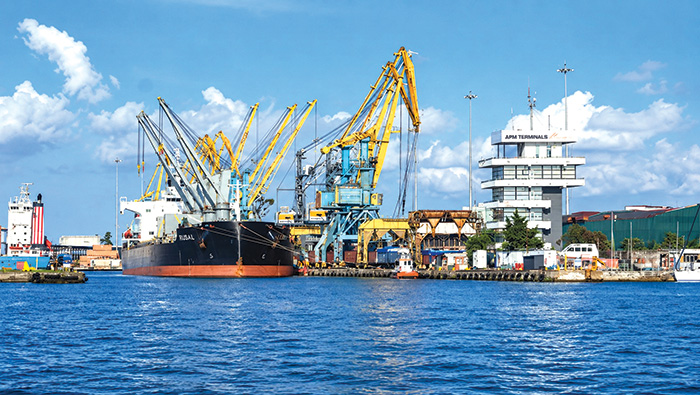
Increasing demand can be seen in the numbers from APM Terminals’ Poti Port, which, according to industry newsletter Ports Europe, is already facing capacity pressure. Between January and July this year, the port handled 404,760 TEU, up 7% year on year, and received 253 container vessels. July itself saw the highest monthly demand ever. The facility handles approximately 80% of the country’s container traffic while also serving dry bulk, liquid bulk, ferry, and other cargo operations. Most importantly, it provides a western interface for cargo travelling between Central Asia, the Caucasus, and the European market.
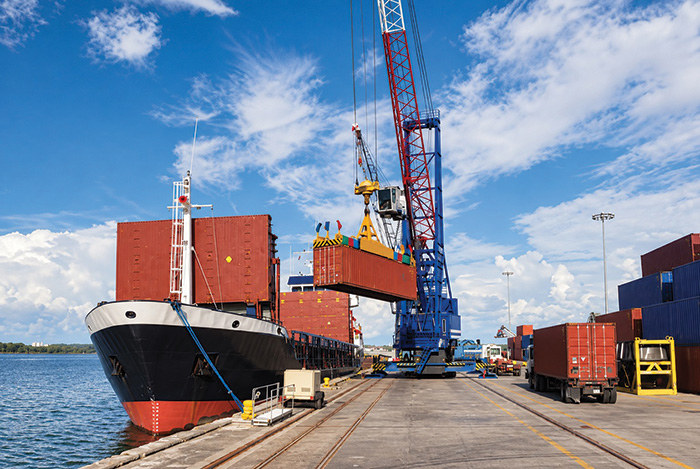
The new Anaklia plan follows a well-established international port template, one used for Rotterdam, Singapore, Antwerp, and Khalifa Port in Abu Dhabi, for example. It is known as the “landlord model” because the government, or port authority, owns and develops the basic maritime infrastructure and road and rail connections, while private operators finance the specialized superstructure—including cargo-handling and industrial equipment—and operate terminals under long-term leases or concessions.
Government figures put the total first-stage capital requirement at about $1.1billion, of which $700 million is expected from the state and roughly $400 million from private investment. The initial phase is planned to provide an annual container capacity of around 10 million tons of dry bulk, with an operational launch targeted for 2029—although that date has met with some industry scepticism. The viability of the port is to be backed by a wider $7 billion state transport modernization program running through 2032. This is to ensure that when the first vessel arrives, Anaklia should be fed directly by upgraded networks, including fully modernized rail and expanded highway routes.
A new model for Anaklia
The latest plan differs from the previous, much criticized model. Announced in 2023, this was planned as an institutional public-private partnership in which a state-owned company would own 51% with a private partner holding 49% and acting as the concessionaire. What particularly drew criticism was that in 2024, the Georgian government chose as partner the Chinese consortium led by the controversial massive infrastructure giant and primary builder of the Belt & Road initiative, the China Communications Construction Company (CCCC). This was despite CCCC’s international history of disputes and failures and the fears that the finance terms could result in it owning the entire port.
There are many advantages of the new model, which diversifies and shares commercial and geopolitical risk as many countries and companies are being invited to invest, operate, and run parts of the superstructure. Georgian ministers have said that the government “will welcome investments in the Anaklia Port by countries who are part of the Middle Corridor–China, the countries of Central Asia, and Azerbaijan.” Also, the terminals can be expanded as cargo volumes materialize, which is particularly useful for a greenfield port like Anaklia that has to prove that there will be enough cargo to justify terminal investment.
Another advantage of this model, mentioned by one Georgian maritime logistic provider, Trans Logistics, was that providing operating opportunities for a wide range of international players encourages competition on pricing. Putting ownership in the hands of the state, Trans Logistics said, was also a signal to the West that the port would not fall under the influence of any particular player, political or commercial. Other industry comment has noted that a broader partnership structure may give more countries a direct interest in moving freight through Anaklia.
A more measured vision
Current descriptions of Anaklia Port are now much more modest than past plans. Investment is half the proposed sum for the $2.5 billion mega-port project of ten years ago, which was designed to compete with Russia’s Novorossiysk port on the Black Sea and thus drew Russian ire for directly challenging its regional shipping dominance. Its capacity seems proportionately smaller—maybe a third to a half—but at this stage it is hard to judge.
Under the new landlord port model announced in July 2026, Anaklia Deep Sea Port is currently described in terms of berth length rather than a fixed number of berths—the initial stage being for up to 700 meters of deepwater container berths and up to 600 meters of jetty-type berths for dry and bulk cargo. The model leaves the terminal layout to be developed in phases by private operators. However, it can be expanded if and when cargo volumes justify adding terminals. The government specifically says the master plan is being updated to determine the “full exploitation” of the port’s potential, including optimal terminal layouts and a phased development model based on cargo demand. Work is being done by Port Consultants Rotterdam, who have consulted for the Georgian government for several years, to update the Anaklia plan.
Key to attracting shipping and logistics companies to the new Anaklia Deep Sea Port is who will be running it. Director of the Georgian think-tank Transport Corridor Research Center (TCRC) Paata Tsagareishvili told BM.ge that Georgia’s main challenges are the country’s ability to manage large-scale infrastructure projects, secure financing, and effectively implement public-private cooperation. Speculation hovers around a handful of names.
Who will come on board?
Poti Port owner APM Terminals (part of international shipping group Maersk) is saying that despite rumors, it is not interested in investing in Anaklia, preferring to make the priority its own Poti operations. In September, Poti Port’s administration head Zviad Chkhartishvili was quoted in online business media BM.ge as saying APM expects the Georgian government and the company to return to negotiations for deepwater berths by the end of 2026. APM is pressing for the project to be included in the government’s long-term transport infrastructure plan, which is in preparation, and wants clarity on how Poti fits into the port strategy.
But while Poti’s owners APM Terminals have been undertaking some expansion work, its discussion with the government on a long-term $300+ million plan for a deepwater port at Poti has been stalled for several years now. APM owns 15 berths and 100 hectares of land at Poti and has also said it needs more information about the government’s new landlord model at Anaklia before assessing the relationship between the two projects.
TCRC pointed to the advantages of bringing to the Anaklia management role either of two massive, state-backed shipping and logistics giants from the United Arab Emirates (UAE) that run major ports, trade hubs, and supply chains around the world. One is AD Ports, which has been expanding its presence along the Middle Corridor. In Tsagareishvili’s view, the company’s activities in the region, including projects in Azerbaijan, Kazakhstan, and Georgia, could create opportunities for future involvement in Anaklia.
The other is DP World, which operates infrastructure—and Georgia is currently a “missing link” in the company’s regional network, which already includes Türkiye, Romania, Uzbekistan, Azerbaijan, Kazakhstan, and China. The company also recently partnered with Uzbekistan’s Tashkent Invest on a $288 million multimodal logistics terminal, designed to connect Central Asia with the Middle East and Europe.
Another name is the Terminal Investment (TIL), the terminal-investment and port-operations business of the giant Swiss registered global air, land, and sea logistic group MSC, which has interests in 23 ports worldwide. Also on the list is major French logistics group CMA CGM, which actively manages and operates port terminals globally through a dedicated division called CMA Terminals Holding.
MSC Georgia is one of the potentially interested groups saying it is currently waiting for the terms and conditions to be announced, supervisory board member Jemal Inaishvili told BM.ge. As the world’s largest container shipping company, with an established presence in Georgia, MSC has been paying close attention to the Middle Corridor and the bottlenecks that continue to constrain the route. According to him, significant infrastructure work will be needed if the government is to meet its goal of receiving the first vessel at the port in 2029. He argues that international tenders should be launched as soon as possible and that negotiations with potential investors and terminal operators for both container and bulk cargo should already have been underway.
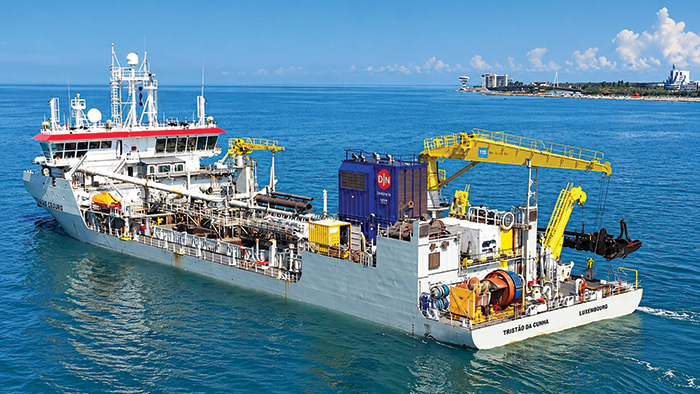
Meanwhile, post the announcement of the new plan for Anaklia, the pace of marine construction work has stepped up. In the last few weeks, the project has moved on from relatively preparatory work and into simultaneous large-scale dredging and breakwater construction, and Belgian contractor Jan De Nul is deploying a second dredger. The eventual target is a water depth of about 17.5 meters, allowing the port to handle substantially larger vessels than Georgia’s existing ports.
Given the geopolitical and economic support for the Middle Corridor and the concept of Anaklia, funding is likely to be available even if the sums turn out to be larger than currently envisaged—the Georgian government has already noted the landlord model will require another $200 million. Most of the major international development banks—the World Bank, the Asian Development Bank (ADB), and the European Investment Bank included—have many port projects on their books. Georgia knows this well, and the landlord model is the dominant institutional one. There have already been announcements of talks on Anaklia with the World Bank and ADB. As regional news outlet EurasiaNet, published by Columbia University’s Harriman Institute, has argued, the move could represent a calculated attempt to secure Georgia’s role in the Middle Corridor while also rebuilding goodwill with Western partners amid the fallout and criticism of the government’s democratic trajectory. Full state ownership of the port could fit within that broader strategy.