
Brewing beyond the cup: how Georgia’s coffee market is evolving
Coffee consumption has become an integral part of everyday life in Georgia. What was once largely a home-based, utilitarian habit has increasingly moved into public space, with coffee now consumed during work meetings, social gatherings, or as a brief pause in the day. This shift has reshaped the entire coffee ecosystem—from imports and roasting to café culture and branding—turning coffee into both an economic and cultural marker.
Against this backdrop, the recent announcement that Starbucks is entering the Georgian market has once again drawn attention to how far the sector has evolved over the past decade, and where it may be headed next.
Imports on the rise: volumes, value, and prices
Coffee imports to Georgia have grown sharply over the past decade. Data from the National Statistics Service of Georgia (Geostat) shows that in value terms, imports have increased by 254%, rising from $14.4 million to $51.1 million. Coffee’s share in total imports in the first 11 months of 2025 was 56% higher than in 2016.
Recent data also points to rising prices. Between January and November 2025, Georgia imported 7,050 tons of coffee worth $51.1 million, compared to $39.3 million for a similar volume a year earlier. This suggests a sharp rise in average prices, despite a slight decline in imported quantities, which is being driven by a combination of global and local factors.
Tamar Chitaishvili is a marketing and project management consultant and former project manager of the Tbilisi Coffee Festival—an annual event that brings together coffee brands, distributors, equipment suppliers, and service providers in Georgia. She says that Georgia’s import dynamics largely mirror broader global trends: supply shortages in major producing countries such as Vietnam and Brazil, climate-related disruptions, higher logistics costs, and stricter European regulations have all contributed to rising raw material prices.
“Georgian coffee import data accurately reflects the global picture,” says Chitaishvili. “Shortages in Vietnam and Brazil increased raw material prices, while European regulations and logistics added further costs. All of this was ultimately reflected in the record coffee prices we saw in Georgia in 2025.”
Changing tastes and the growth of café culture
Beyond price inflation, rising imports point to a gradual shift in consumer preferences. Chief Operating Officer of Costa Coffee Georgia Elene Jgerenaia says demand is moving toward higher-quality beans and more consistent blends—a trend that has not gone unnoticed by international coffee brands.
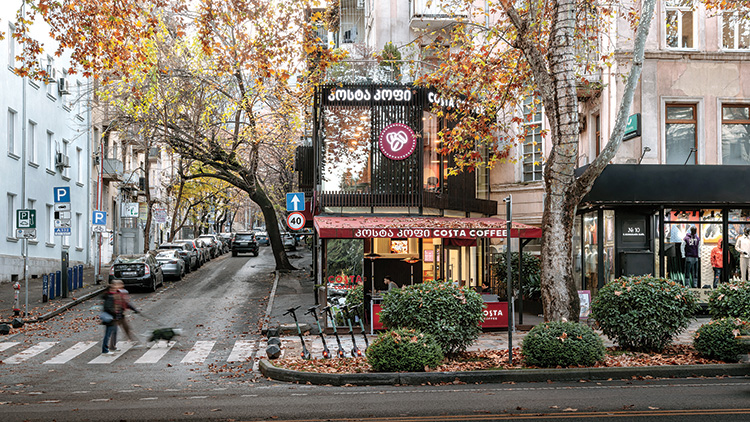
UK-based multinational chain Costa Coffee entered the Georgian market a year ago “with the aim of bringing an international-standard coffee experience as close as possible to local consumers,” Jgerenaia says. Only five months after the start of operations, the chain announced it was expanding and opening its first branch in Vake on Ilia Chavchavadze Avenue, “introducing customers to Costa’s quality, fast service, and comfortable environment.” The chain currently operates three locations in Tbilisi.

While the growing interest of multinational chains signals the maturation of Georgia’s coffee market, the real engine of this transformation started with local specialty cafés. Independent cafés and roasters such as Coffee Lab (opened in 2016) and Shavi Coffee Roasters (opened in 2021) have played a crucial role in reshaping coffee culture by educating consumers about bean origins, roast profiles, and brewing methods—turning coffee drinking into a more conscious and increasingly social experience.
This growing emphasis on quality and education is also reflected in the rise of industry events. Launched in 2023, the Tbilisi Coffee Festival has grown rapidly, becoming a key platform for showcasing Georgia’s evolving coffee scene. By its third edition in 2025, the exhibition hosted around 50 participating companies and attracted approximately 5,000 visitors, alongside master classes, panel discussions, and interactive programming that connect professionals and consumers alike.
As interest in specialty coffee has expanded beyond cafés and festivals, the same shift is increasingly visible in retail and distribution channels. Founder of Coffeehub.ge Nika Begiashvili says he has witnessed first-hand how demand and consumer choice have expanded over the past six years.
“When I worked as a digital sales manager in a coffee company, I saw how quickly demand and variety were growing,” he says. “Many brands were not represented in retail, and it was difficult for consumers to access them.” In response, he created Coffeehub.ge, an online platform that brings together local and international coffee brands and presents them to consumers in one place, to better “unite the coffee available on the market.”
Industrial roasting: big ambitions, thin margins
Despite growing consumption, rising imports, and the popularity of small specialty coffee roasters, building a viable industrial coffee production business in Georgia remains a challenge. Financial data from the country’s main large-scale producers suggests that local industrial roasting is a difficult—and often unprofitable—segment in a small and price-sensitive market.
A FinSpot analysis published in July 2025 examined three of the largest companies—Meama, Mondo, and Cherie—and found that Georgia’s two pure-play producers, Meama and Cherie, are currently operating at a loss.
Meama, the country’s largest coffee producer, continues to operate despite losses through significant capital injections from its owners, with total investment exceeding ₾100 million.
By contrast, Mondo is the only company among the three that has remained consistently profitable, likely due to higher-margin sales of imported coffee and equipment rather than local production.
Starbucks, Costa, and the future of coffee competition in Georgia
In early December 2025, Georgian media reported that Starbucks would enter the local market, with its first branch expected to open in March 2026 in Tbilisi’s Vake district. According to BMG, the brand will operate under a franchise agreement with the Arab Alshaya Group, with operations in Georgia managed by the group’s Turkish office.
The arrival of multinational chains such as Costa Coffee—and now Starbucks—marks a new phase for the Georgian coffee market. Sector experts expect the impact to be mixed but largely transformative.
On the one hand, the presence of global brands is expected to intensify competition, encourage greater investment in marketing and personalization, and raise overall service standards. On the other hand, Starbucks is likely to accelerate the premiumization of coffee consumption.
“Starbucks doesn’t sell the best coffee—it sells status, environment, and stability,” says Tamar Chitaishvili. “The cafés most at risk are those in the middle: neither true specialty cafés nor strong brands. The main beneficiaries could be local artisan cafés. A customer who learns to drink coffee at Starbucks will eventually demand higher quality and move on to smaller, quality-oriented places.”
Founder of the Tbilisi Coffee Festival and Coffee Academy Mikheil Parulava agrees that Starbucks’ entry is unlikely to bankrupt existing players. Instead, he believes it will expand the market and deepen specialization.
“It may have a positive effect on the coffee shop business as a whole,” Parulava says. “The main challenge will be pricing. Starbucks is often positioned higher than McDonald’s or Dunkin, and Georgia is very price sensitive. The key question is how the company will sustain operations after the initial excitement fades.” While challenges remain—particularly around profitability and price sensitivity—the sector’s rapid evolution over the past decade suggests that coffee will continue to play an increasingly important economic and cultural role in Georgia.