
Georgia widens the window for international investment with SME bond issuances
Georgia’s capital markets are adding diversity, attracting international investors by giving access to promising niche, high growth sectors.
Under an Enterprise Georgia program, a total of 12 companies issued bonds last year, raising around 900 million GEL ($334 million). While this was a relatively small percentage of overall funding on the capital market, it highlights the increasing volume diverted away from bank borrowing—a move sought by the international investment banks that are keen on reducing the bank-centric nature of the country’s financial landscape.
Most of these companies are not exactly tiny, but, as they come from economic groups and sectors the government wishes to encourage, they have been able to benefit from an Enterprise Georgia scheme offering technical and financial incentives to drive bond issues from small and medium-sized enterprises (SMEs). This has opened windows on vibrant sectors in the economy aligned with the resilient consumer industries, and introduced hitherto relatively unknown names to international funds. Included are outdoor advertising leader Alma, fast-growing micro bank MBC, and shopping mall front-runner MP Development.

The companies’ bonds have been received with enthusiasm by local banks’ investment departments, international funds, and Georgia’s pension fund. These placements were managed by TBC Capital and Galt & Taggart: Alma and MP Development bonds were placed by TBC and Galt & Taggart, and TBC placed the MBC bond.
Alma
Outdoor advertising company Alma is one of Georgia’s star SMEs bond issuers, at the very top of the SME sector in scale with an industry sector share in Tbilisi of around 90%—and highly profitable. In fact, when Forbes business magazine ran its calculator over Alma’s numbers to create an assessment of the company’s value, it ranked Alma on its criteria as the country’s No. 14.
In July, Alma announced the issuance of bonds, making its debut in the markets and becoming the first advertising company traded on the Georgian Stock Exchange. The issuance involved two separate tranches to refinance existing bank liabilities. A dollar tranche, aimed at raising $30 million, carries a coupon of 8.5% and matures in July 2027. A EUR tranche, aimed to raise up to EUR 8.5 million, carries a coupon of 7.5% and also matures in July 2027.
The National Bank of Georgia’s comment was that Alma’s debut issuance “attracted strong interest from both local and international investors, with participation from more than 150 individual and institutional investors.” The internationally attractive yields were 8.5% on the dollar issue and 7.25% on the Euro one.
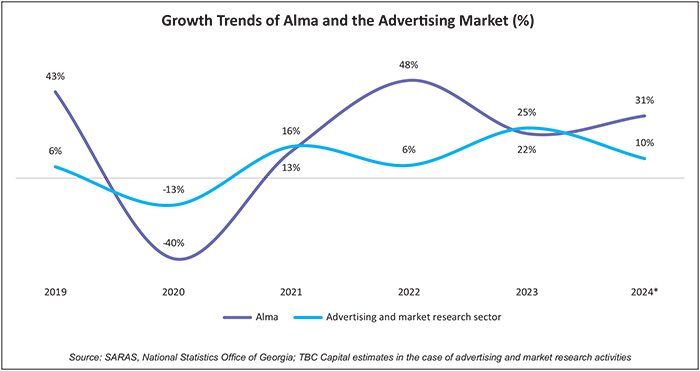
Alma’s chairman is Business Association of Georgia Chair and Wissol Group President Soso Pkhakadze. The company was formed in 1995, joined the Wissol Group in 2013, and since 2016 has been steadily adding services. If its name is not well-known, its products certainly are as they range from billboards on bridges, buildings, and rooftops; light boxes and dynamic video screens for ad displays in both Tbilisi and Batumi airports; and ads at bus and metro stops and on buses. Alma owned over 1200 billboards at the end of 2024 and has its own printing facilities and installation and maintenance teams. It offers up to ten advertising channels to its core large corporate clients across the country.
Major customer sectors last year for Alma were retail and online, international organizations, developers, and governments and embassies. No separate figures are published for Georgia’s advertising market—it is bundled with market research in the country’s official data gathering, and this has shown strong growth. According to the National Statistics Office of Georgia, in 2023, post-Covid total turnover was GEL 922 million—representing a 25% increase compared to 2022. The compound annual growth rate for the 2019–2023 period was 7.3%.
Alma’s borrowings shot up by 55% in 2024, as it needed to finance obtaining the permit for placing advertising media in Batumi. Its total liabilities rose to GEL 158 million, hence the bond issues.
MP Development
From the same parent company (Wissol Group) have come bonds from MP Development, the property management company with a significant portfolio that includes major shopping centers in prime locations across the country—18 sited in Tbilisi and in other cities in Georgia. These centers encompass a total rental area of over 70,000 square meters and host more than 400 partner shops, attracting around 21 million visitors annually.
MP Development was established in 2012. A private company, it is owned apart from Wissol, which is now one of Georgia’s largest holding companies, by the investment firm Riverside Invest. Founders are listed as Levan Pkhakadze and Tamar Gamgoneishvili, with Papuna Katsitadze as the current CEO.
The company’s primary focus is the development and management of commercial properties. Its declared mission includes “driving the growth of international brands within the Georgian market,” supporting regional development, and creating jobs.

MP Development’s latest development, an excellent example of the company’s strategy, is the recently launched 30 million GEL multifunctional shopping mall in Telavi. CEO Papuna Katsitadze told Commersant that the opening of the space will be divided into several stages, the first stage being the opening of the 5,000 sq. m. shopping center. Telavi Mall will house a cinema, food outlets, and clothing stores.
“We have tenants such as a cinema, a grocery store, a pharmacy, and clothing brands, including LC Waikiki. Also, perfume brands and others. There will be a full-fledged shopping center, including food outlets. There will be a three-hall cinema, where the company Dream Cinema will operate, which is new to the Georgian market. We are negotiating with McDonald’s in the food section,” Katsitadze said.
The development will cover four hectares overall, and services will be expanded gradually. “We intend to open a building materials hypermarket Domino on the remaining 5,000 m². In addition, we plan to arrange a furniture sales center, similar to Saba in Tbilisi. We plan to place a health center and a car service in the future,” Katsitadze added.
Three MP Development bonds are currently listed on the Georgian Stock Exchange: one EUR 3 million issue, maturing in July 2026; and two dollar ones, of $5 million and $17.7 million, maturing in July 2026 and April 2027 respectively. The coupons are 7.75%, 8.75%, and 8.5%.
MBC
In MBC, investors have the chance to engage with another thriving sector of the economy—the financing of the country’s small businesses. MBC was formed 12 years ago as a microfinance organization by several former founders, executives, and shareholders of Basis Bank who brought to it a combination of banking and business experience.
In December 2024, it became Georgia’s first microbank. Soon after, in February 2025, microfinance organisation Crystal also obtained a microbank license, expanding the nascent sector.
Key people and founders of MBC include its CEO Gia Petriashvili and Murman Ambroladze (both founders of Basis Bank). In its new form as a microbank, MBC’s supervisory board is chaired by Murman Ambroladze. It is owned by 13 shareholders, the most significant of whom are Gia Petriashvili (31.8%) and Otar Rukhadze (14.4%).
With 17 service centers in Georgia, a loan portfolio of 119.5 million GEL, assets totaling 145 million GEL, and over 184,000 customers, MBC is now transitioning to a new phase of development. As its latest annual report states, despite the “challenging domestic environment,” towards the end of 2024, the European rating agency Scope upgraded MBC’s credit rating, confirming the company’s stability and reliability. Preparing for the move to microbanking, the company invested to upgrade its IT sector and began the process of opening customer current accounts.
Transitioning to a microbank allows MBC to add to its product range by taking deposits and providing current accounts. As Scope points out in a report on Georgia’s microbank sector, growth opportunities also come from the fact that, compared to microfinance institutions, microbanks can “grant larger loan tickets,” that is, up to one million GEL. Scope’s report on MBC says it had a market share of approx. 21% in the microbank niche segment as of September 2025.
The entry of microbanks is expected, Scope states, to “enhance financial-sector competitiveness, expand the range of product offerings and services,” and by supporting entrepreneurs, help drive economic growth. It adds: “Assuming 20% annual growth in lending volumes, the sector could reach one billion GEL in 2026.”
In May 2025, MBC announced GEL 21.3 million of two-year bonds, the variable interest rate set at TIBR 3M + 4.0%, with the Pension Fund of Georgia participating as one of the investors, marking its first-time purchase of microbank bonds. Then in October, MBC issued GEL 30 million in two-year public bonds, marking the second and final tranche of its bond program under the Enterprise Georgia Capital Market Support Program – this issue was oversubscribed, demand exceeding supply.
In addition to funding from the bonds, MBC has secured financing from Swiss market access platform Symbiotics and the European Fund for SouthEast Europe ($16 million) and the Armenian and South Caucasus bank Inecobank ($5 million).
Funding for smaller SMEs
Companies really at the small end of Georgia’s corporate sectors currently obtain funding assistance via banking routes. They are targeted by a range of international assistance programs which largely funnel funding though the international development banks and then to local commercial banks. The EU is the largest foreign supporter of private sector development in Georgia through its extensive EU4Business program. This initiative provides funding, guarantees, and technical assistance in partnership with other IDBs and local financial institutions. For example, the EBRD partners with the EU on several programs, including the EU4Business-EBRD Credit Line and the Women in Business program. They provide loans and grants through local partner banks like TBC Bank, Bank of Georgia, Credo Bank, and others, as well as microfinance organizations.
However, work is being done on alternative financial platforms which could provide new avenues for SME finance. The National Bank of Georgia is focused on developing a national fintech strategy, and this includes supporting the licensing of digital banks and the potential for new online lending platforms and payment initiation services. Policymakers and industry stakeholders are discussing ways to foster equity financing options that are currently underdeveloped in Georgia. These include encouraging a more mature VC market to provide capital for innovative, high-growth potential businesses and exploring regulatory frameworks (such as regulatory sandboxes) to facilitate both equity-based and lending-based crowdfunding platforms.