
Georgia’s ICT sector after the surge: growth, risks, and the skills gap
Georgia’s ICT Association has announced encouraging news. Contrary to fears that Georgia’s largely migrant IT workforce might prove temporary and leave the sector exposed, the IT industry is showing strong organic growth. The first three-quarters of 2025 recorded foreign income of $791 million, a 66% increase on a year earlier, and higher than the whole of 2024.
“This will not only be the effect of migrants, but also the stabilization and natural growth of the sector,” Tornike Sulaberidze, chairman of the supervisory board of the ICT Association, told BM.ge. The gain reversed a dip in 2024, when the market had become saturated, and reflected an increase in services and the exports of IT companies that have moved to Georgia.
ICT (Information and Communication Technology) has for the last three years been described as the most dynamic driver of the country’s growth, so growth is vital. In 2025, ICT attracted global business, employed over 50,000 in 24,265 registered IT companies, chipped in 8.2% of nominal GDP with 7 billion GEL of turnover, and had exports of $898 million (up 53%) in the first nine months alone.
However, Georgia’s ICT sector is very international with a global client list, and thus exposed to all the hazards of tech’s evolution worldwide. Questions are repeatedly posed on how long Georgia’s growth can continue, especially as the key IT workforce and companies are heavily foreign. According to the latest report on the industry, the pace can only be maintained if the country upskills its home-grown talent and expedites improvement in its telecommunications infrastructure, which lags regional peers.
Investment bankers Galt & Taggart stated in December that: “Overall, sustaining IT sector growth will require deeper workforce specialization, accelerated upskilling, and continued infrastructure improvement to boost ICT exports and drive long-term economic transformation.”
Startup activity accelerates
The IT startup scene in Georgia is attracting international attention in particular this year, as it rapidly develops as a regional hub, driven by unprecedented government tax incentives, strong international accelerator partnerships, and a focus on high-impact tech sectors like AI and fintech. Government funded drivers range from grants from the Georgian Innovation and Technology Agency, to plans for a dedicated “StartUP in Georgia” digital platform, and an International Innovation Hub in San Francisco to position Georgian startups on the global stage.
Four major international accelerators—Plug and Play, 500 Global, Founder Institute, and Startupbootcamp—are now actively running Georgian programs for up to 160 startups for funding and networking. These give access to global networks, mentorship, and significant follow-on investment opportunities.
Fintech remains the country’s strongest startup sector, bolstered by a record $180 million in VC funding in 2024 and 2025. Emerging sectors for 2026 include AI-driven logistics, Web3, and iGaming. Government strategy is to boost the tech sector by focusing on strengthening local tech hubs (like the one in Kutaisi with AI and TUMO centers), and fostering Agritech. These companies leverage IT solutions such as AI, IoT, robotics, and data analytics to improve farming efficiency, yield, and sustainability.
ICT sector by the numbers
Georgia’s ICT community is, in fact, larger than indicated by the numbers above, especially in IT. The registered ICT industry is dominated by computer programming and IT services, which by late 2025 account for about 59% of total sector revenue. This is also the fastest-growing segment and is largely export-oriented, with the United States and Europe as its main markets. Telecommunications, once the largest part of the industry, now make up roughly 23% of ICT revenue. Key developments in 2025 include record levels of mobile service spending and the continued rollout of 5G and gigabit LTE networks. Information services contribute around 8% of total revenue and remain an important area for diversification, while software publishing—including both software and book publishing—maintains a stable share of about 6% of overall ICT turnover.
There are far more with IT skills than just those working in registered IT companies – Microsoft-owned GitHub, the web-based platform for hosting, managing, and collaborating on software projects, is said in the industry to host around 7,644 Georgian organisations and 140,000 Georgia-based users. This number could include Georgian students (12,000 IT students are enrolled at 21 universities), hobbyists, and workers in firms not classified as ICT, such as banking, retail, or government. It highlights the extent of participation in international projects and visibility to global employers of Georgia’s IT talent.
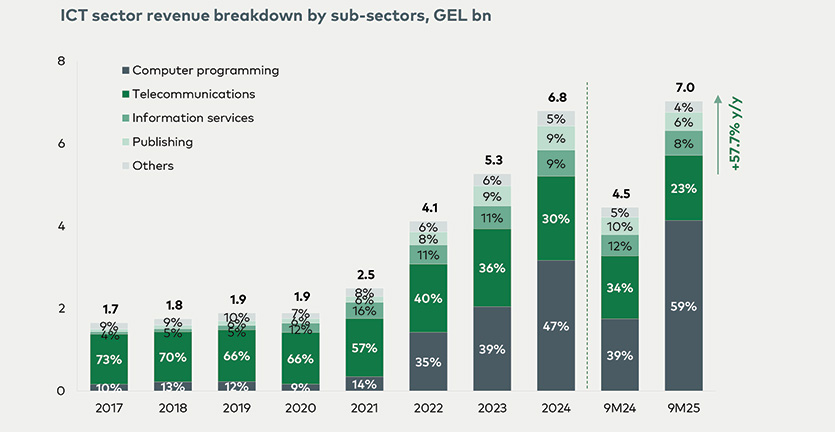
This reflects fast growth for a fairly new industry. The first boost for the Georgian ICT industry came in 2020 with the government introduction of generous tax incentives, enticing international companies and IT specialists to relocate to Georgia. That was followed two years later, after the Russian invasion of Ukraine, when IT professionals from Russia, Ukraine, and Belarus took refuge in Georgia, providing a second boost and bringing skills as well as their businesses.
Skills and infrastructure gaps
The 2022 wave of migrants created a potential challenge as well as a bonus as relocated international professionals comprise roughly 93% of IT service providers as of 2025, according to Galt & Taggart. And a report last July from Georgian NGO the Institute for Development of Freedom of Information found that 56% of Georgia’s IT companies were Russian. These professionals could relocate again, working remotely and as freelancers, as many do. So, Georgia’s ICT industry is vulnerable, lacking sufficient home-grown professionals with the wide experience to match that to be found among the waves of migrants.
While high-for-Georgia average salaries in the IT sector (at 6,911 GEL a month according to Galt & Taggart, twice that in the business sector) and attractive career prospects have made computer programming a popular career choice, local graduates face international competition and lack experience. At the same time, AI adoption and automation have reduced entry-level labor demand. Plus, says Galt & Taggart, “Many graduates enter the market with theoretical IT skills, while employers increasingly demand specialist job-ready competencies (e.g. cloud, AI/ML cybersecurity, DevOps).”
IT services exports from Georgia are impressive, showing the far-reaching international profile of the clients, and thus their ability to recruit globally. In 2025, 26% of IT service exports went to the US, followed by 10% to the UK, and 8% each to Malta and Germany. Major exporters include:
Enterprise Solutions & ERP: Companies like LeverX (USA-based) operate in Tbilisi as global system integrators for SAP implementation and customization.
Fintech & Trading Platforms: Firms such as Devexperts (Germany) develop trading platforms and brokerage automation for the global fintech industry.
Cloud & Communication: France-based Ringover.
iGaming: SOFTSWISS and Singular Group utilize Georgian talent to develop advanced iGaming software solutions for international markets.
Nearshore Outsourcing: Companies like Intelvision and Exadel provide dedicated development teams for European and North American clients, specializing in fast onboarding (2–4 days) and “AI-native” development.
Others with major operations in Georgia include logistics players like Girteka (Europe’s largest asset-based transport company) which has established GBS hubs in Georgia to centralize IT and business operations. International investors, including Binance, have established blockchain hubs to advance regional education and development. Epam Systems, one of the largest global IT providers has a significant workforce in Georgia. Another global player, Exadel, has a base in Georgia for its global software consulting. Lineate & JettyCloud are major international IT providers that relocated significant operations to Georgia following the regional geopolitical shifts.
So, there is a lot to lose if Georgia’s relocated tech professionals relocate again. There is already a skill/experience mismatch, as Galt & Taggart points out. Technology adoption has accelerated dramatically over recent years, fundamentally changing what employers need from tech professionals The rise of AI, increased cybersecurity threats, cloud migration and data-driven decision making are all shifting skill requirements, according to La Fosse, a significant international recruitment organisation in the tech sector. Companies increasingly seek professionals “who can bridge traditional technical skills with newer competencies like AI implementation and cloud architecture, combining these with a clear understanding of the “why.” Fortunately, many of the skill shortfalls facing Georgia are shared by its international peers, so the situation also offers opportunity—if Georgia can upgrade its skills and infrastructure.