
When the milk runs dry: Georgia’s cheese sector has a dairy problem
Georgia’s cheese market is expanding in value and variety, yet the raw milk supply that underpins it is steadily eroding. As local production falters, rising imports and structural weaknesses are reshaping one of the country’s most traditional food sectors.
Georgia’s cheese market is showing disturbing trends. Despite rising demand, the rediscovery of traditional varieties, and the central importance of cheese in Georgia’s cuisine and culture, local production is failing. Georgian farms cannot meet demand and cheese, butter, and milk have joined Georgia’s fast growing agricultural imports. The cause is a decline in local milk production.
While a seasonal winter fall in milk supply usually brings higher prices for cheese at this time of year, the trend in the underlying deterioration in the milk supply could make this year’s rise sharp. One Kakheti dairy company, Marita, reported that milk shortages had already pushed up its prices by 1-2 GEL in November, and thought that further rises were inevitable. “We are trying to balance costs so that the products remain affordable for the consumer, but it does not depend only on us,” Keti Bolkvadze, the company’s co-founder, told BMGTV in December.
Demand is booming—but milk is disappearing
Georgia’s shrinking milk production, as the population abandons livestock farming, was described in the same program by Nona Ansiani, founder of Kvemo Kartli raw milk processing enterprise Shvanre: “The production of raw materials in our region is decreasing year by year. People see they cannot make a profit in this area, so they slaughter or sell their cattle. This has led to a very large shortage of milk.” She adds that she foresees that the country will “become increasingly dependent on imports.”
Efforts are being made to avoid that. Some government and international support is going to the sector. Plus, efforts to raise the status of Georgian cheeses and their prices in order to make dairy farming more attractive to farmers are increasing, creating premium and export markets.
There are now regional and Tbilisi cheese festivals, there is a digital and physical tourism trail connecting artisanal cheese producers across Georgia—https://cheeseroute.net—emulating the Wine Route. There are sites and maps for gourmet tourism. A Georgian Cheese Makers’ Association has been working to revive and promote Georgia’s rich cheese heritage. Education is pushing to enact the quality standards that are necessary for many export markets. But, all this has failed to stop the threat to Georgian cheese production.
Nikoloz Beniaidze, founder of the dairy producer Shiraki explained to BM.ge that last summer’s drought had been a major contributor to the current shortage: “…prices are still exceptionally high compared to previous years…because in summer, there were droughts in Kakheti and Kvemo Kartli for three months, there was no grass, therefore, the amount of raw milk decreased. Milk production is greatly reduced.” Plus, he added, farmers’ inputs were escalating each year. So “the number of dairy cattle decreases every year. Industrial farms are also not growing and new farms are not opening in the country.”
Demand for cheese is certainly not the problem, the Georgian cheese market is actually gaining in overall value and range and is now valued at $190 million. A report from Georgia’s Business and Technical University (BTU) points out that international research groups, such as Euromonitor and Strategy Helix, are forecasting strong growth in demand, with an annual increase of 7-8% a year. Statista has an even higher figure, at nearly 9%. Adding to the normal demand for traditional cheeses, the variety of artisanal and gourmet cheeses available is exciting, particularly for goat cheeses and ancient regional cheeses. Demand is also being created as products with cheese ingredients—like pizza—are becoming increasingly popular consumer choices.
Why farmers are exiting dairy
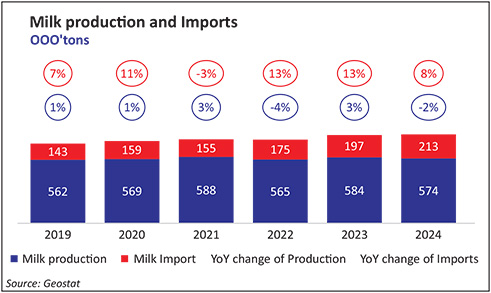
Georgia’s raw milk production is falling because the national dairy herd is shrinking, skilled labor is in short supply, and costs of production are rising all the time. In 2024, annual milk production was down 2.3% on 2023, at 570.7 million liters. Production in 2025 dropped 3% in the first quarter, to around 108 million liters. The number of dairy cows also fell to 396,000, a decline of 20,000 head compared to the previous year. By Q3 2025, milk production was down 9.1% and cow numbers by 5.2% compared to the same time in 2024.
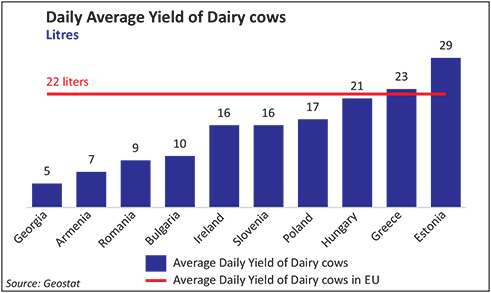
This signals that there is increasing economic pressure on small farmers, many of whom struggle to modernize or maintain production, according to Geostat. There have been many rising costs. Apart from the expense of feed and labor, prices for equipment have increased, making dairy farming less profitable. Lack of investment, according to a recent TBC Capital report, has left Georgia’s average milk yield at only 4.7 liters per cow, compared with the European Union average of 22 liters, highlighting extremely low productivity in the domestic dairy sector. Raw milk imports have risen, growing by 45% in the first ten months of 2025 compared to the same time in 2024. Milk powder imports have reached their highest level ever, says the report, rising from about 8,000 tons in 2019 to 11,600 in the first 10 months of 2025.
Given the strength of the meat export market, and the lack of profit in dairy, 2025 saw, not surprisingly, an increase in the export of live cattle, further impacting the number of milk-producing animals. According to Geostat, 21,300 head of cattle were exported in Q1 2025—nearly three times more than the same period last year.
These cattle may not be replaced—not by imports, anyway. In Q1 2025, only 2,700 head of cattle were imported, compared to 7,500 for Q1 2024. This, says BTU, implies that either local supplies are sufficient or that the cost of importing has increased sufficiently “to push the market towards an export-orientated strategy.” Chairman the Association of Commercial Milk Producers Nikoloz Beniaidze told Commersant that the price of high-yielding cows has risen from around €2,000 to over €3,000.
Imports fill the gap, at a cost
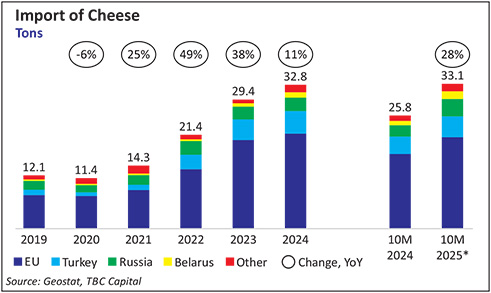
To fill the cheese supply-demand gap, Georgia imported $33 million worth of cheese and cottage cheese in January-October 2025, a rise of 28.1% on 2024, states Geostat. From January to July 2025, the country imported about 11,100 tons of milk and cream worth $12.4 million, again according to Geostat, which is a sharp rise of 28% from the 7,500 tons worth $8.9 million during the same period in 2024. Most of the imports originated from neighboring Azerbaijan, followed by Poland, Russia, and France. Other suppliers included Belarus, Turkey, Germany, Italy, Ukraine, and Iran.
Exacerbating the problems for Georgian dairy farmers, according to Nona Ansiani, is that “products made from raw milk and powder have almost the same price on the market.” While world prices for milk powder have been falling, farming costs in Georgia have been rising.
Imported milk powder from countries where there is overproduction of milk can be priced at very low levels. “…Cheap powdered milk is imported at dumping prices,” maintains Nikoloz Beniaidze.
Registered dairies in Georgia have struggled to compete with the black market of unregistered producers who use cheap imported milk powder. This also suppresses the market for authentic, locally-produced raw milk. In 2024, Georgia imported over 10,000 tons of powdered milk, an 8% increase YoY. Key suppliers include Belarus, Iran, Russia, the Netherlands, and Germany. But, illustrating the competitive price of imported milk powder, despite the increased volume, the total value of imports dropped by 6%, totaling $23 million, due to lower global prices, according to Geostat.
This farming crisis is by no means a new one. Given the importance of agriculture in the economy, the state of Georgia’s farms has been a source of concern ever since the country’s independence. There are many long-standing and well-documented challenges that have been contributing to the low productivity of Georgian dairy farming, including small-scale, non-intensive farm operations, inadequate feeding practices, and poor veterinary care. A large number of Georgian government and international programs have been conducted to address the problems and have shown mixed but generally positive results, focusing on modernizing the sector through strategies like the EU-backed ENPARD and FAO/UNDP and USAID support. However, many hurdles persist in the form of rural poverty, low productivity, market access, land degradation, and climate change.
The latest government measure addresses the need to consolidate the highly fragmented farm structure, with a three-and-a half year program to create larger and more efficient farming units and attract investment. The project is being implemented by the Food and Agriculture Organization of the United Nations (FAO), with financial support from the World Bank.
Meanwhile, many family farms continue to sell their cow, sheep and goats cheeses through informal channels like local markets. This may be good for local cash flow, but this can lead to inconsistent quality and hygiene standards, and make it difficult to track production volumes and sales. However, the cheeses continue to please consumers. According to a report from the International School of Economics at TSU several years ago, up to 90% of Georgian cheese was being produced by unregistered producers, and it stated that this was “not surprising because according to Geostat, more than 97% of milk in Georgia in 2017 was produced by family farms.”
However, there are a number of large-scale Georgian cheese producers, even if they collect their milk from family farms. They include Sante GMT Products, Shiraqi, Georgian Dairy Products, Blauenstein Georgia, Natural Producktsai, and Wimm-Bill-Dann Georgia. Several of these also feature among the major importers.
Currently, fresh efforts to increase milk production are being attempted, through modernization grants, low-interest financing, and the introduction of higher-yielding cattle breeds. For its Dairy Modernization and Market Access program, the Rural Development Agency (RDA) resumed receiving applications in July 2025. It provides co-financing for: construction and equipment, building animal stalls and acquiring small equipment necessary for farm arrangement; and sustainability, with funding available for solar power plants (2–4 kW).
In early 2025, the government increased the limit for seven-year dairy farming loans to 10 million GEL, with the state subsidizing a portion of the interest. And there is international support. The United Nations’ International Fund for Agriculture Development’s $16 million dairy farming program continues to support small and medium-scale producers in regions like Imereti and Samegrelo-Zemo Svaneti, targeting improvements in artificial insemination and milk collection. Further solutions are being tried, aimed at trying to make small farms more efficient. However, despite the initiatives enacted to date, the figures from 2025 showing an escalating decrease in milk production are hardly encouraging for Georgia’s cheese producers.